



For more photos from my trip, check out my tumblr!
Also, if you don’t know what One Piece is, this post will probably hold little significance to you. My apologies! As a One Piece fan, this is a little self-indulgent of me.
My tutor, who’s been to Japan, once told me this:

I was a little confused. I asked him to elaborate.

One Piece, for those who don’t know, is a manga/anime series that’s been running in Japan for over ten years. It’s about a quirky pirate captain, Monkey D. Luffy, and his quest to find the fabled treasure “One Piece” and become king of the pirates. Throughout his travels, he accumulates a small and equally quirky pirate crew and together they roam the seas. They challenge the elements, other pirates, and even the World Government, weaving a wacky tale of epic adventure.

One Piece also happens to be one of my favorite series, due to its skillful blending of humor and action. It’s kind of well-known in America, too, if you’re into Japanese manga and anime. And I knew it was popular in Japan.
But I was not prepared.
For just how popular it was.
One of the first things I noticed in Japan was just how prevalent One Piece was. One character from One Piece– Tony Tony Chopper– is this little reindeer… thing. He’s cute. Therefore, every single souvenir shop we went to had a whole section devoted to solely Tony Tony Chopper phone charms.
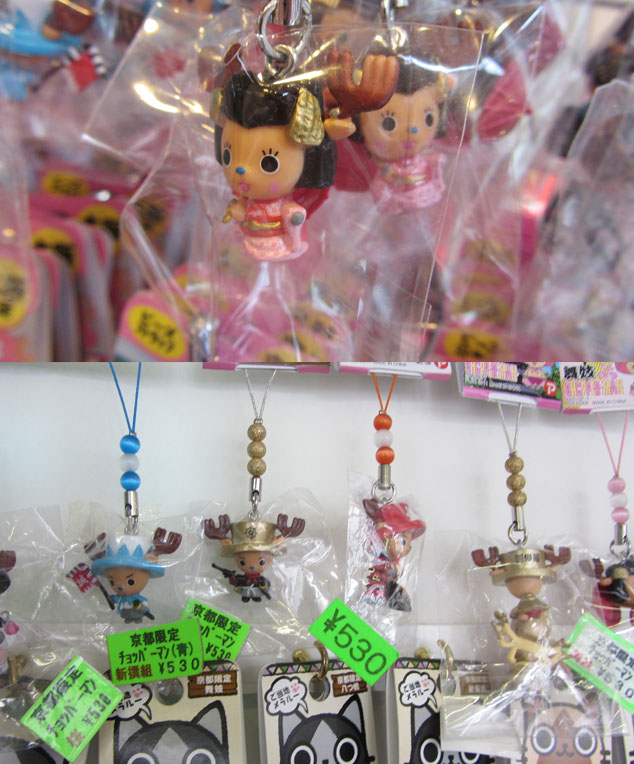
Of course, the phone charms weren’t limited to Chopper alone. There were plenty of the other characters as well.
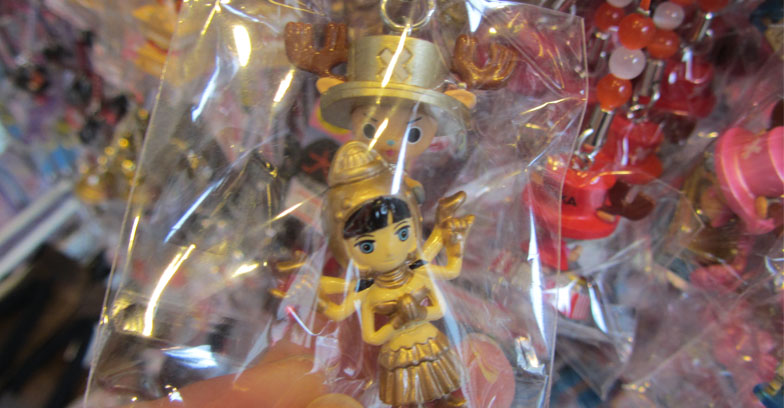
Like Nico Robin.
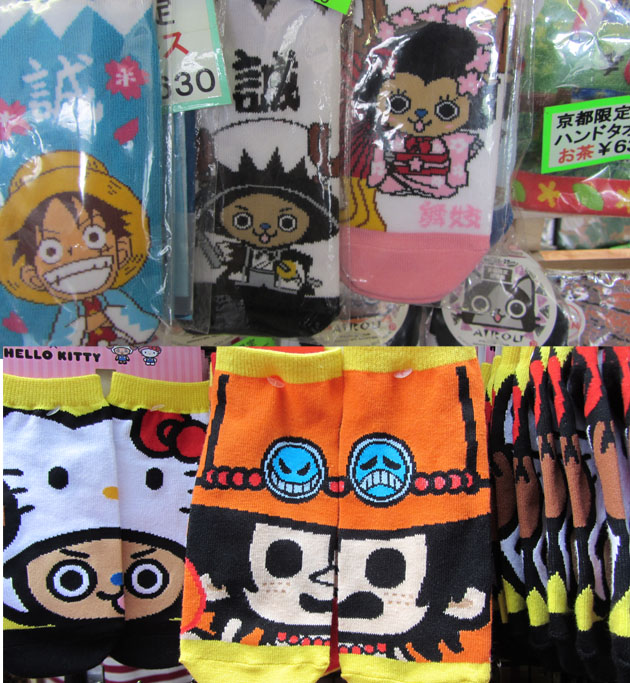
The merchandise was not limited to phone charms. There were plenty of One Piece socks…
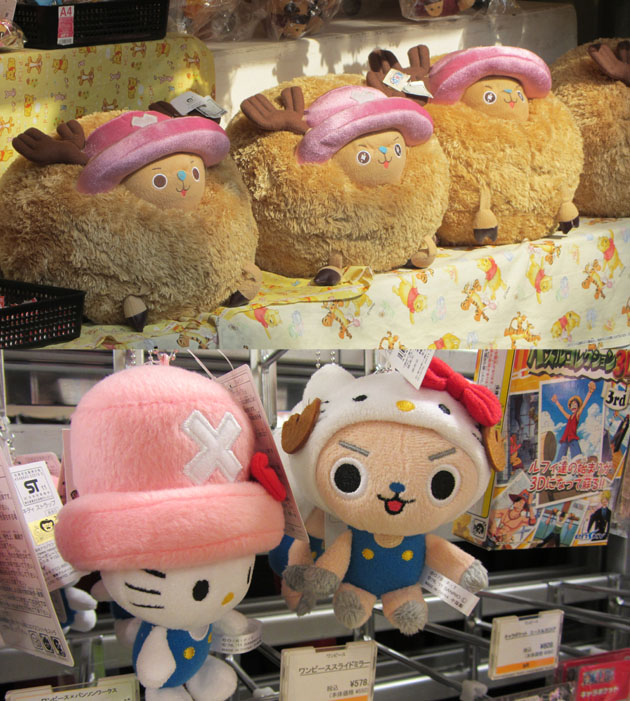
One Piece plushies…
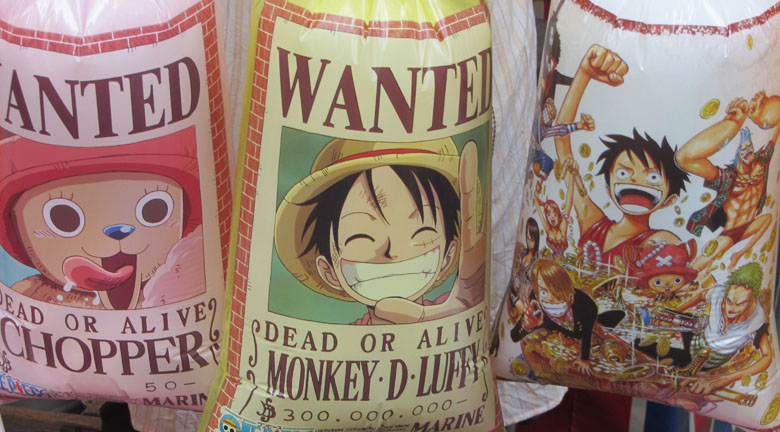
One Piece bags of popcorn…
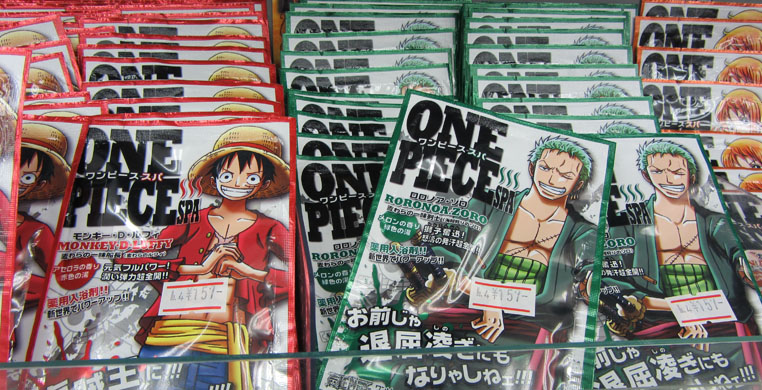
Even One Piece…bath salts?
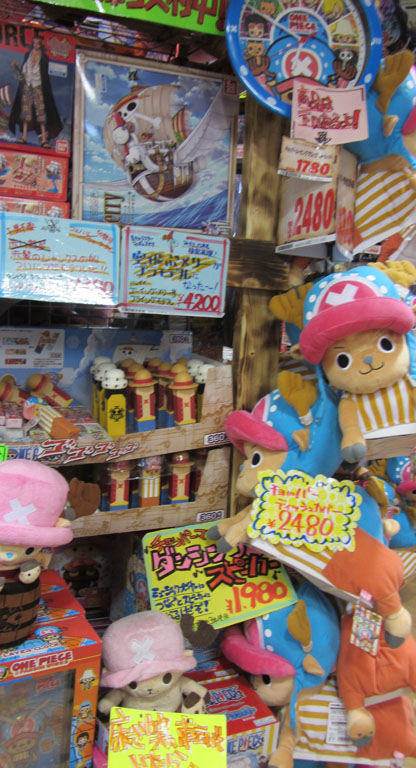
A lot of the stores I went to had whole sections devoted to One Piece.
It got even crazier when I realized that a lot of the One Piece souvenirs were created for that specific area. For example, in Tokyo, we’d see phone charms, of, say, Tony Tony Chopper sitting on Tokyo tower.
Or, at Noboribetsu, a hot springs town, we’d see One Piece characters at the hot springs…
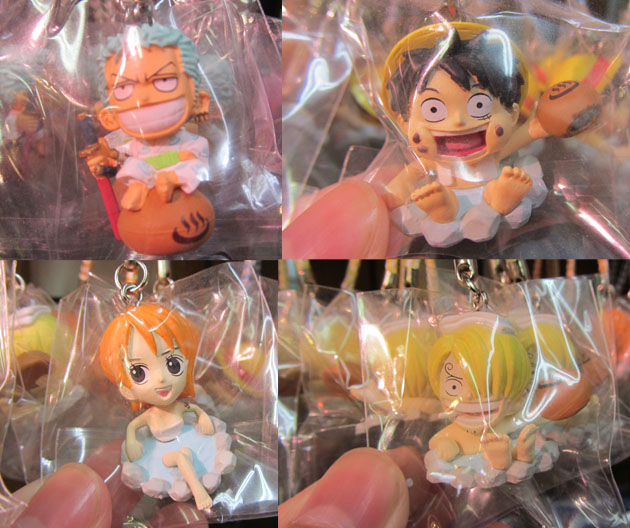
Or, at Sapporo Dome, we saw One Piece characters playing soccer:

Japanese souvenirs, as we found out, are a bit different in that way. One Piece wasn’t the only line of characters sold with their own specialized souvenirs. Hello Kitty, for instance, could also be found in most stores:
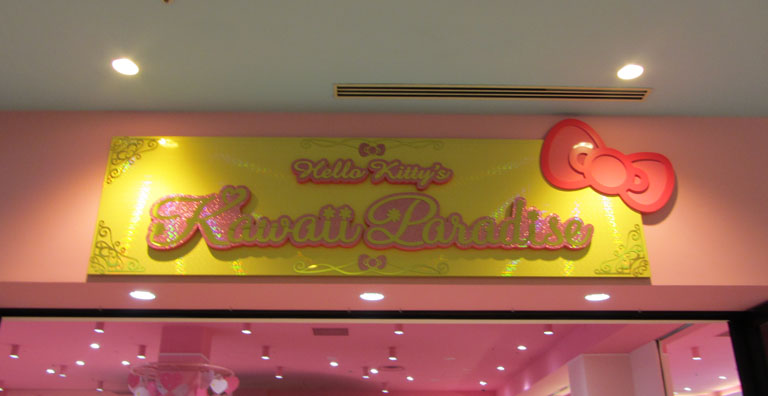
Though this just happened to be a whole store devoted to Hello Kitty.
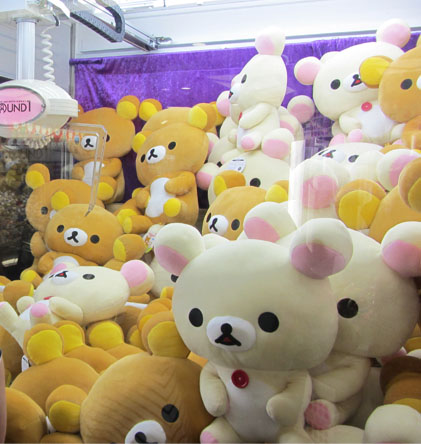
Another commonly seen character was a bear named Rilakkuma:
There was even a Hokkaido-specific character called Marimokkori, a portmanteau of marimo (a type of green algae ball that grows in Hokkaido’s lakes) and mokkori (a slang term for “erection.”) As you’d expect, some of Marimokkori’s merchandise was a little… weird.
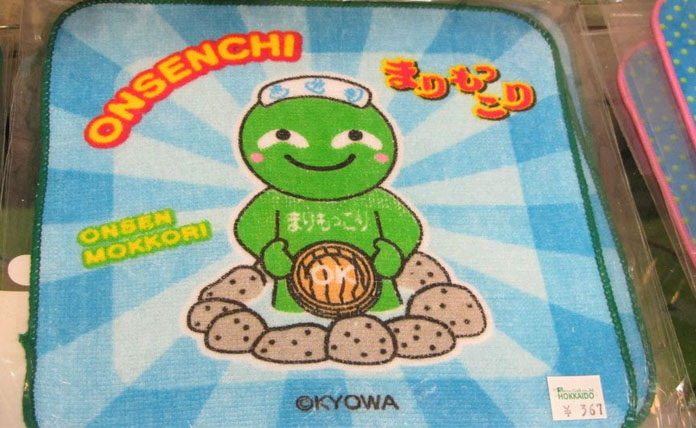
But One Piece was, by far, the most popular. It was everywhere. It pervaded daily life. One of our students had a host brother in elementary school who wore only One Piece t-shirts. I’d often ask people if they watched anime– and the answer would often be:

Occasionally it worked as a conversation starter.

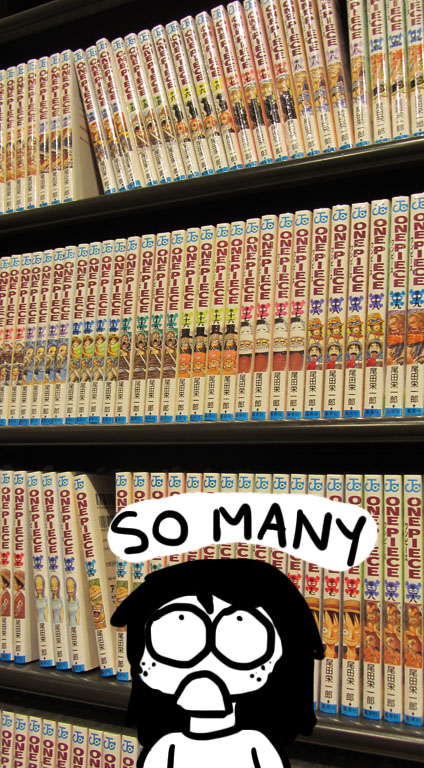
The extent of the popularity of One Piece didn’t hit me, though, until I entered a book store. First, I saw the One Piece section:
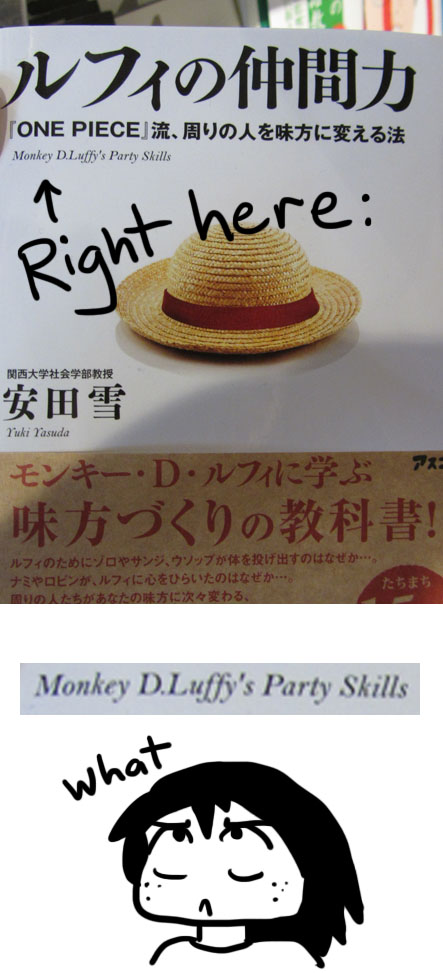
And then I saw a book of One Piece… “party skills?”
And then I saw this series of books:

And finally, the kicker:

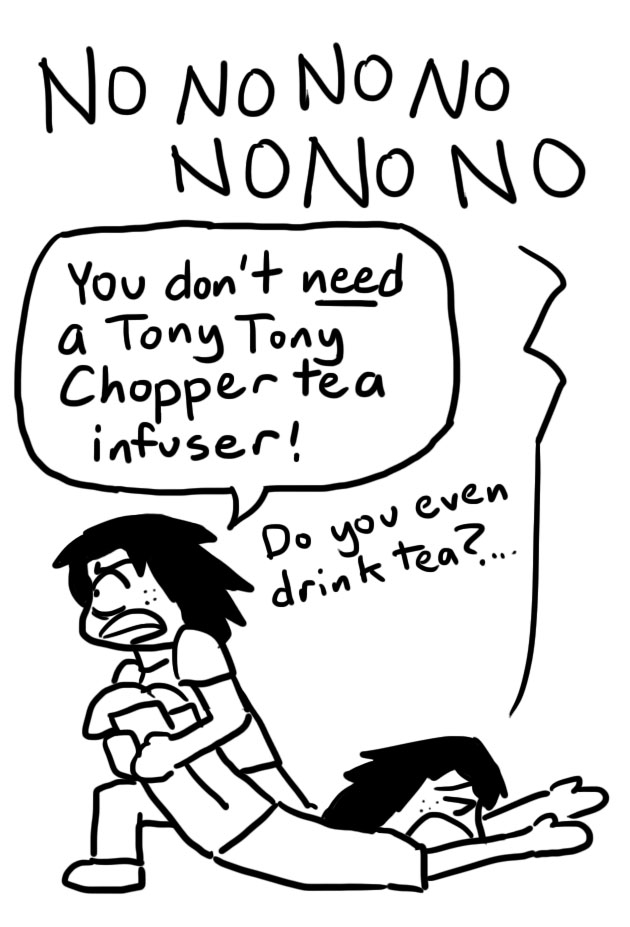
Therefore, my trip to Japan was one of the most trying times of my life. Due to temptation. To my wallet.

So One Piece in Japan was extremely popular to the point where I was shocked. It’s kind of like the Harry Potter of Japan in terms of popularity, except in America there isn’t Harry Potter stuff in all the stores. Really, I’ve never seen anything just be that popular before. Luckily, I managed to practice some self-restraint and not buy everything…
For photos from my trip, check out my tumblr!
One interesting issue my group encountered while in Japan was the fact that we were gaijin.
I mentioned it before, but I barely scratched the surface. I’ll explain again: the term gaijin, composed of the kanji 外 (outside) and 人 (person) literally means outsider. Gaijin is actually a bit of a colloquial term– if not sometimes derogatory– with the more formal term being gaikokujin (foreign-country person.) Japan, due to its long history of isolation, is a very homogeneous country. In other words, everyone is Japanese. As my language teacher put it,
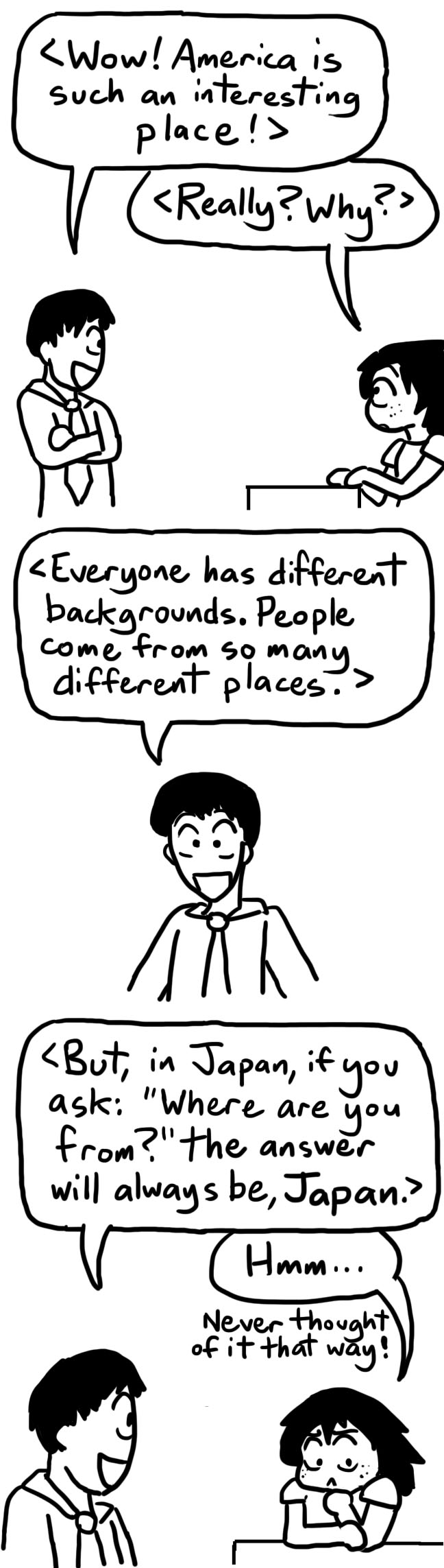
And it’s true. 98.5% of Japan’s population is, well, Japanese. And to split up the remaining 1.5%– 0.9% of Japan’s residents are Korean or Chinese, and only 0.6% are from other countries. Gaijin. We are rare.
So we encountered some interesting behavior as a result.
We’ll start with the middle school kids. Two places I encountered in particular– Nara and Kiyomizudera— are popular locations for school trips. As a result, both places are swarming with grade schoolers, many of whom aren’t shy:
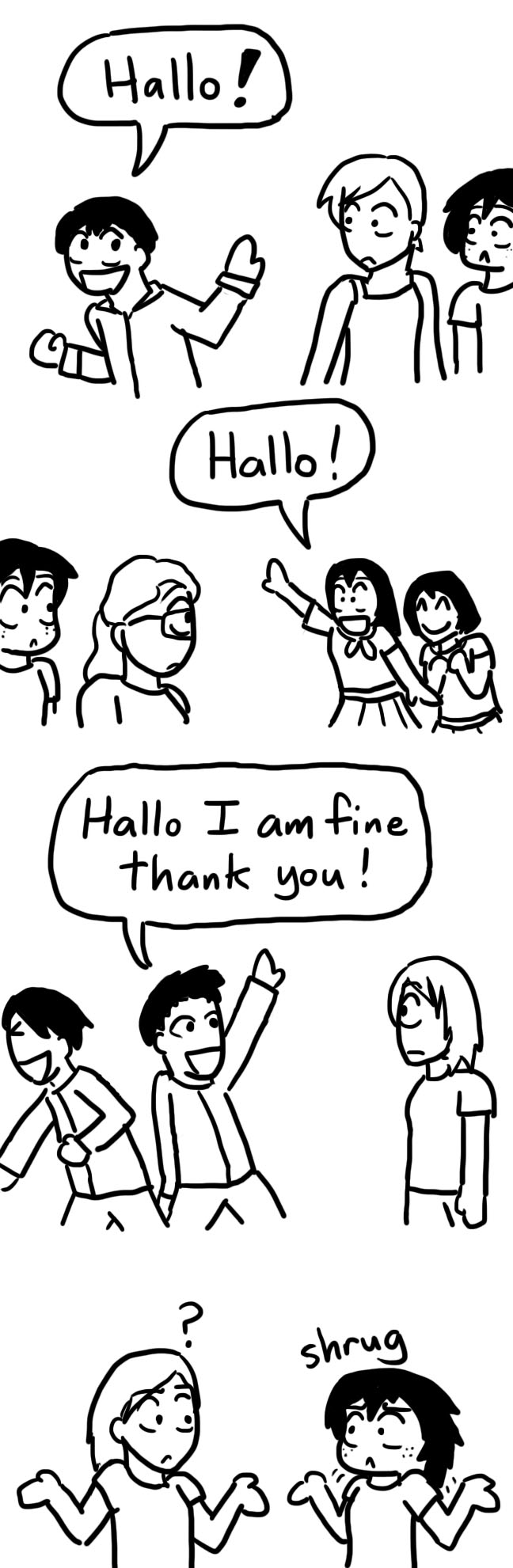
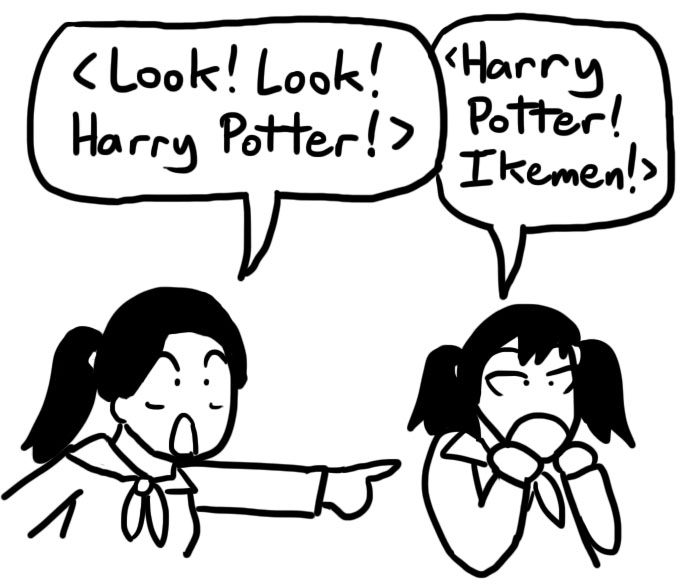
Openly pointing, staring, and shouting are all fair game when you’re a gaikokujin. Not that it’s mean spirited– one thing we’d often hear was ikemen! (hot guy!) One Caucasian, glasses-donning kid on our trip even got
Nara and Kiyomizudera are popular attractions for tourists, as well. It seems as though Japanese teachers know this. Literally dozens of students stopped us on the streets to ask us school-assigned questionnaires in English:
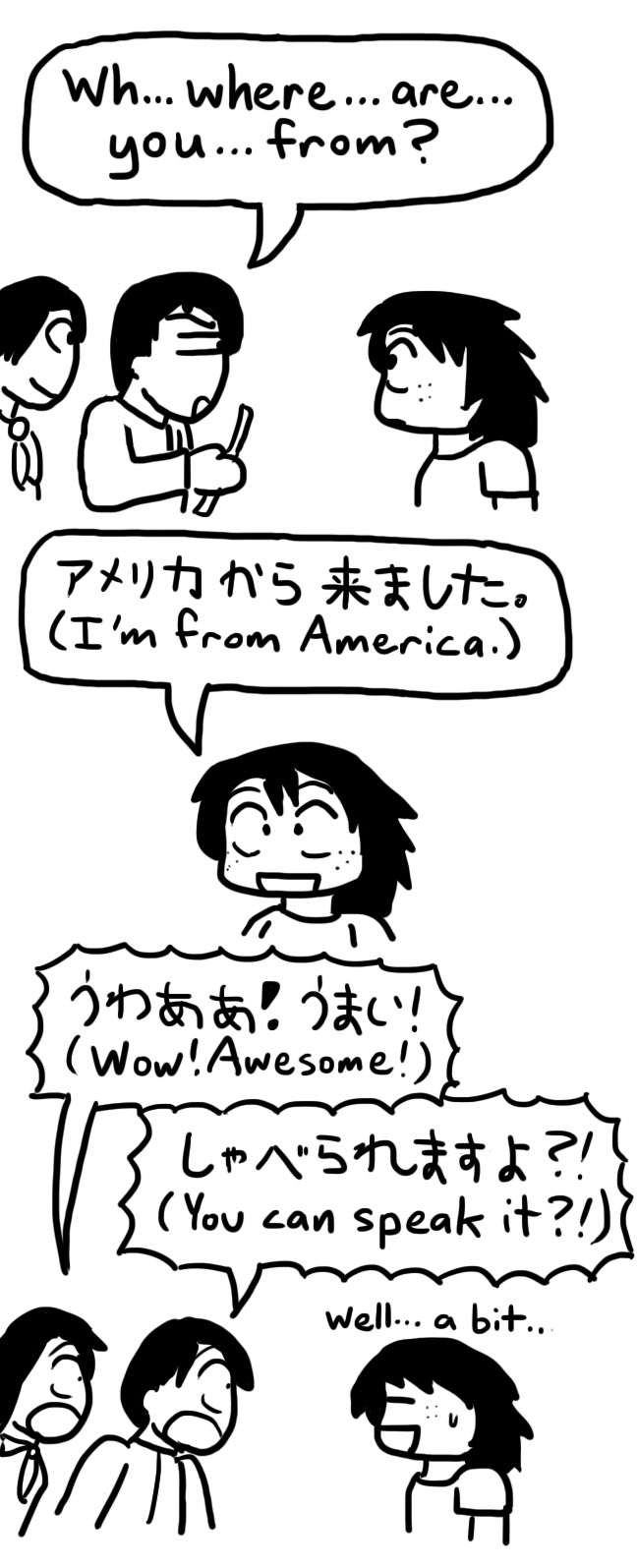
Literally. Dozens. We almost missed the train home from Nara as a result.
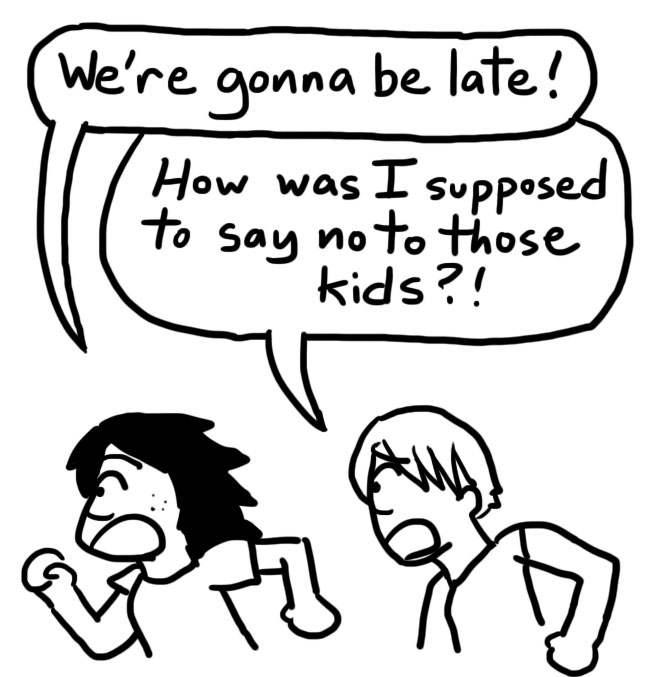
As a group of 18 Americans, the gaijin complex was strong. I mentioned already that people were shocked that we could speak Japanese…
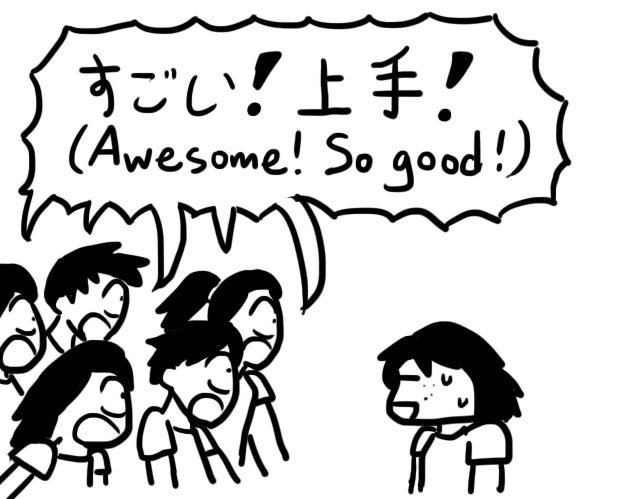
…and, even when we proved that we could speak Japanese, people would keep speaking English as though we couldn’t understand.

Granted, it’s because the standards for gaijin are so low in Japan. There are so many Americans who move to Japan, live there for years, and still not know a lick of Japanese. I can’t blame the Japanese for assuming that we can’t speak their language, because– truly and honestly– I can’t yet. Not well.
So we were novelties, and often treated as such. Every time we would take group photos together, there’d often be a Japanese person or two who’d surreptitiously snap a photo of us.
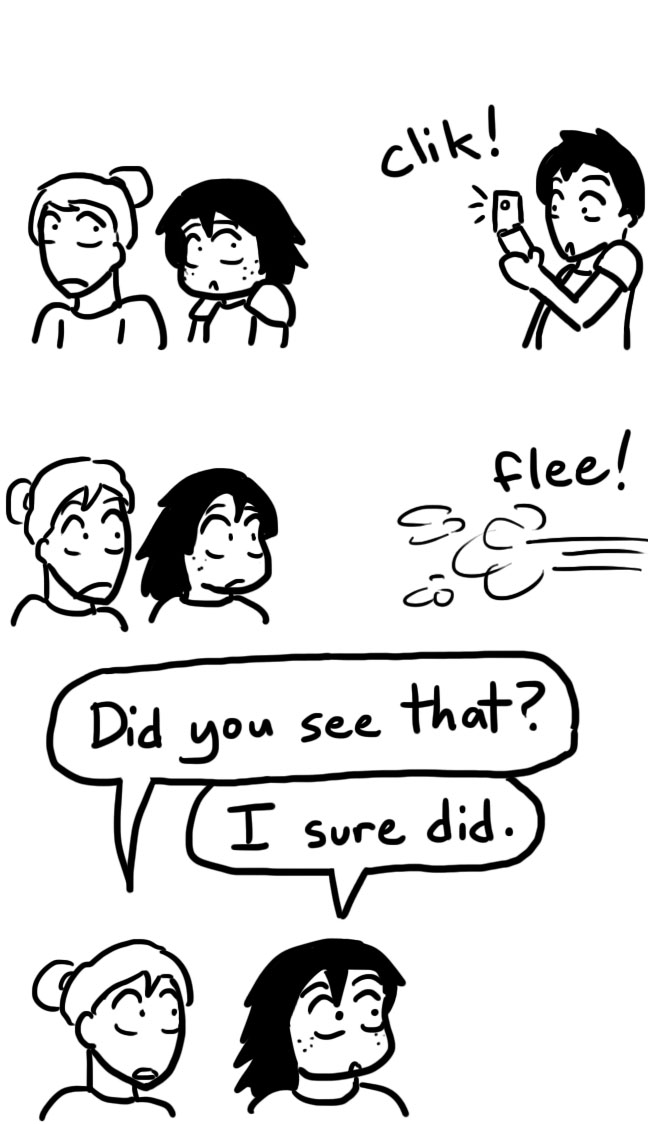
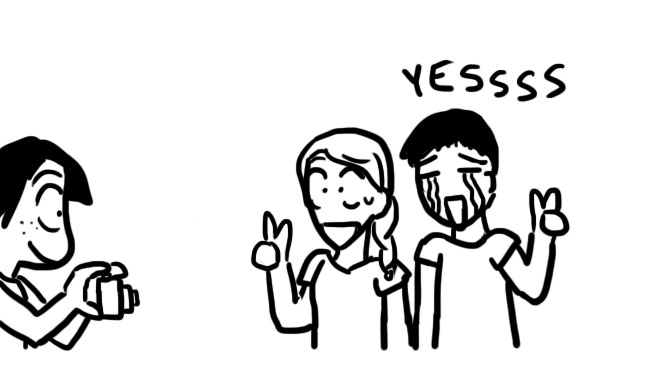
And some were a little more forward. One girl in our group– tall, blond, blue-eyed– was asked by a Japanese guy to take a photo together.
On one of our last days we marched in a parade through Sapporo, traditional yukata and all. One student in our group, a half-Guatemalan girl, evoked one particularly strong reaction:

The stories go on and on and on. Not all are positive. Sometimes, we were intentionally served later in restaurants or on plane rides. One girl was ogled by passing boys who thought that she didn’t understand their sleazy comments. A Chinese student on our program was declared to be, by an elementary schooler, “Made in China.”
Most of our encounters, though, were not malicious in intent. Rather, they simply stem from a lack of understanding between the two cultures. Westerners in Japan are immediately branded with a set of stereotypes: can’t use chopsticks, can’t speak Japanese, loud and boisterous… and hey, a lot of the time, it’s true. So when my group defied these stereotypes, we were met with genuine surprise.
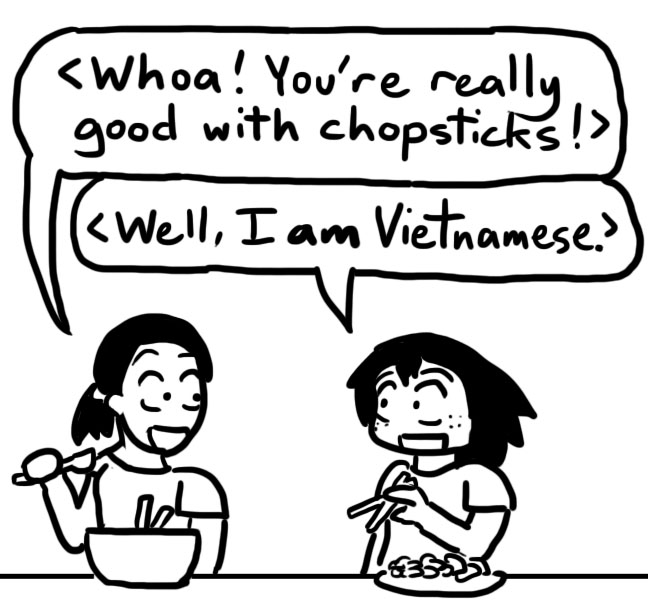
And the people around us were extremely welcoming. I stayed with an awesome host family, met some incredibly kind college students in Kyoto and Tokyo, and really just found people to be understanding of my, well, gaijin-ness. We got a lot of leeway, for sure.
Still, I wonder if the culture gap will one day be bridged. I asked one of my fellow students how he felt about the matter:
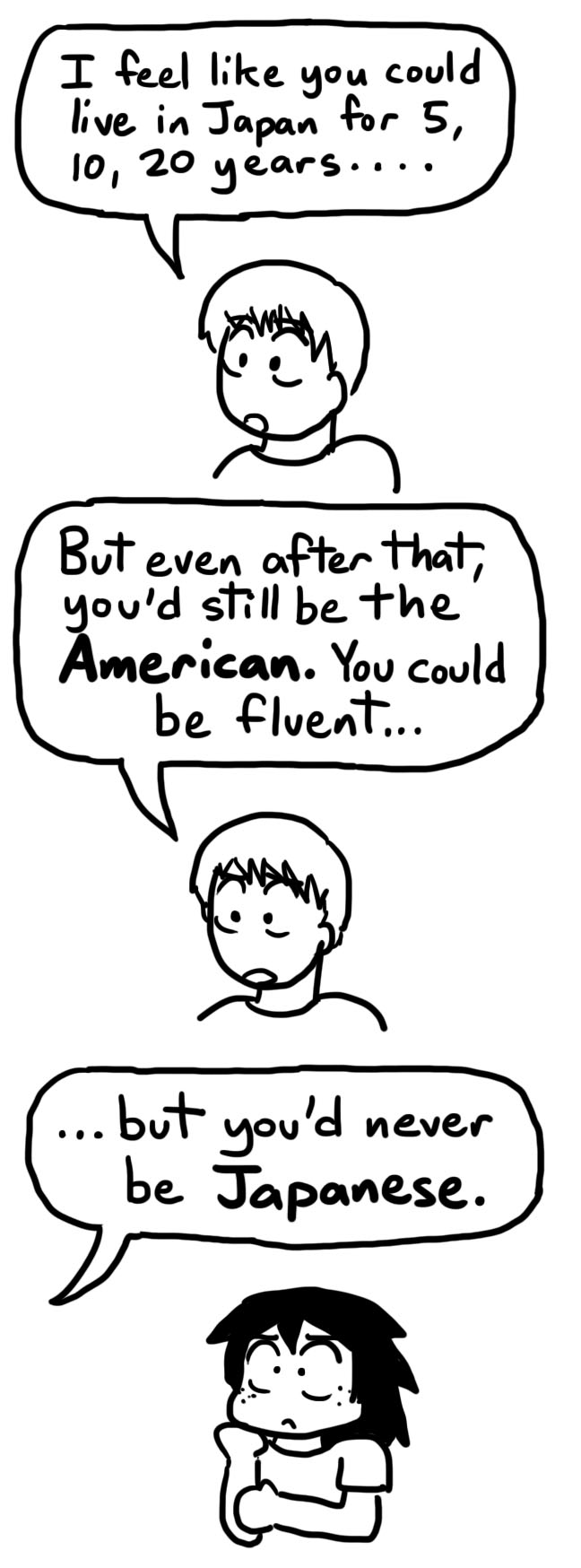
By the end of the trip, some of the kids were definitely a bit frustrated from being treated like a gaikokujin all the time. But, I suppose that’s what an exchange program is all about. Crossing countries. Knocking down stereotypes. Allowing us to share our culture in exchange for learning the culture of Japan. There are certainly tons of stereotypes about Japan floating around America. The more we learn about each other, though, the more we can realize the truth. It just takes a little effort and an open mind.
One of the most impressionable conversations I had was in Tokyo, where I met up with my Japanese friend from high school and his mom:

I only hope that, in the future, I can learn more and more.
Heya!
Before I start this nutty comic, I’m going to add some context for those who are unaware:
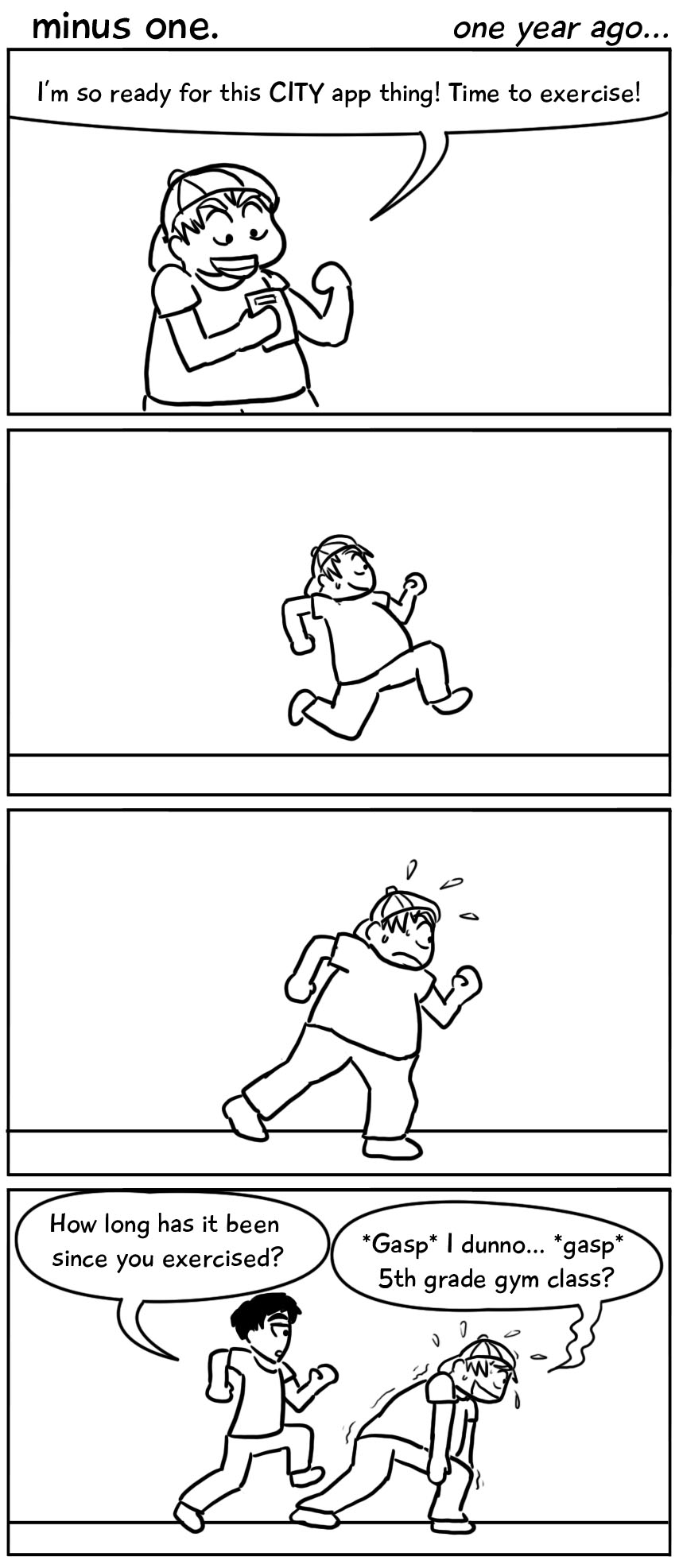
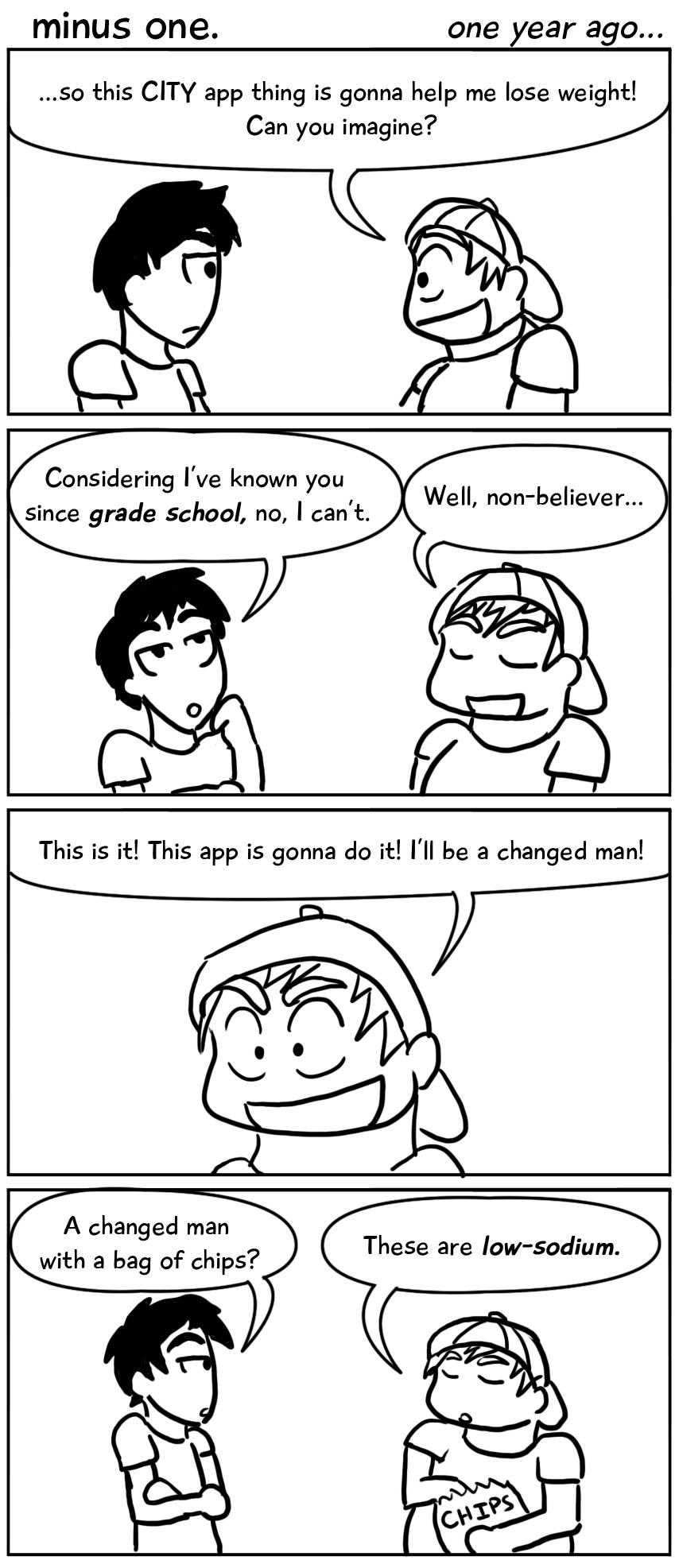
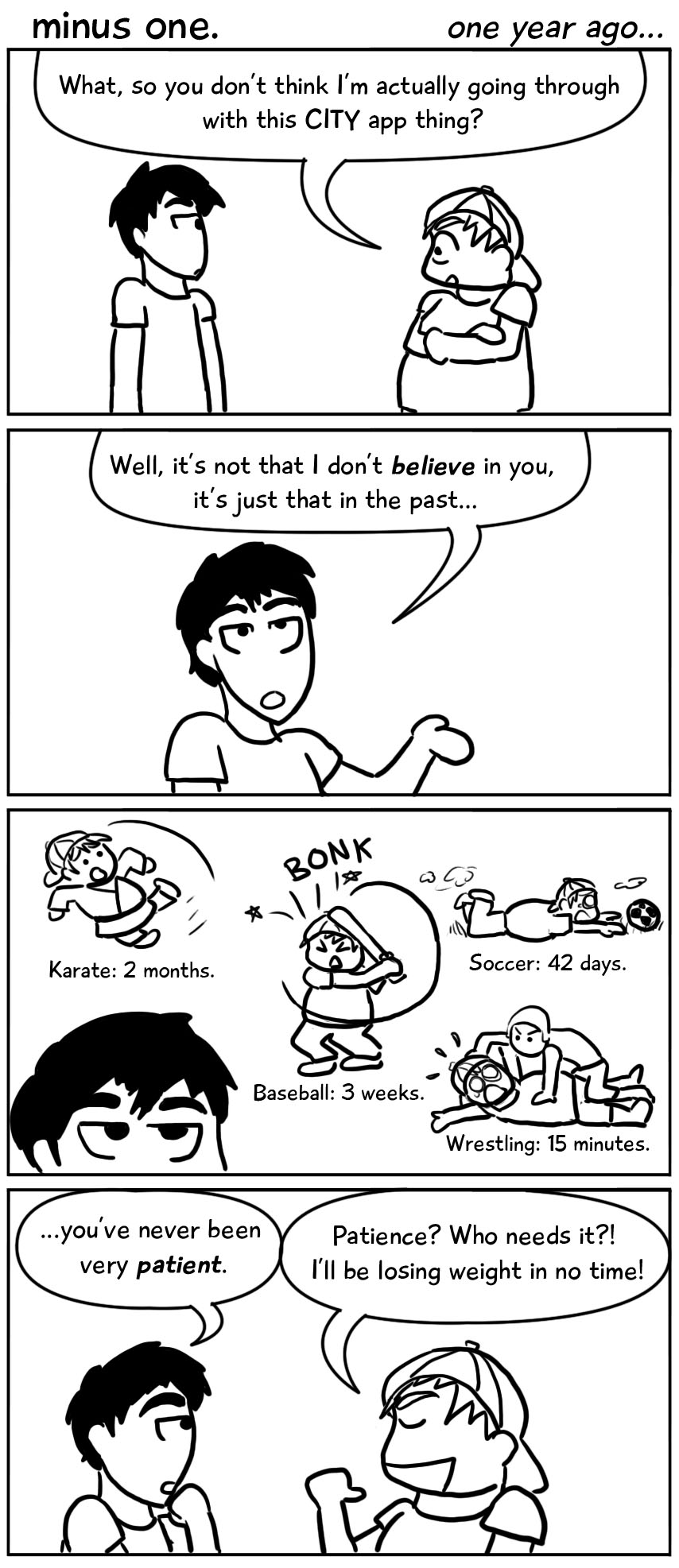
This is a comic about weight loss. There’s this study being done at my school, where participants use their cell phones to help them lose weight. They use this program called the CITYapp, where they can input their food and exercise to track the amount of calories they’re consuming. In addition, the phone also prompts them several times a day as a reminder. It’s kind of like using Weight Watchers or Livestrong or My Fitness Pal on your phone, except your phone is also constantly pestering you.
And, as this study is for two years, your phone is pestering you for two years.
People get sick of it.
That’s where I come in. The professors in charge of this study wanted to give this app some pizzazz. Something that would make it interesting enough for people to keep using it. Therefore I was hired to draw comics for the CITYapp, in the hopes that it would make people want to use their phone. I came in when there was a year left in the study– and since the participants use their phone every day– I was told to write a comic for each day, for a year.
These are those 365 comics.
365 comics about weight loss.



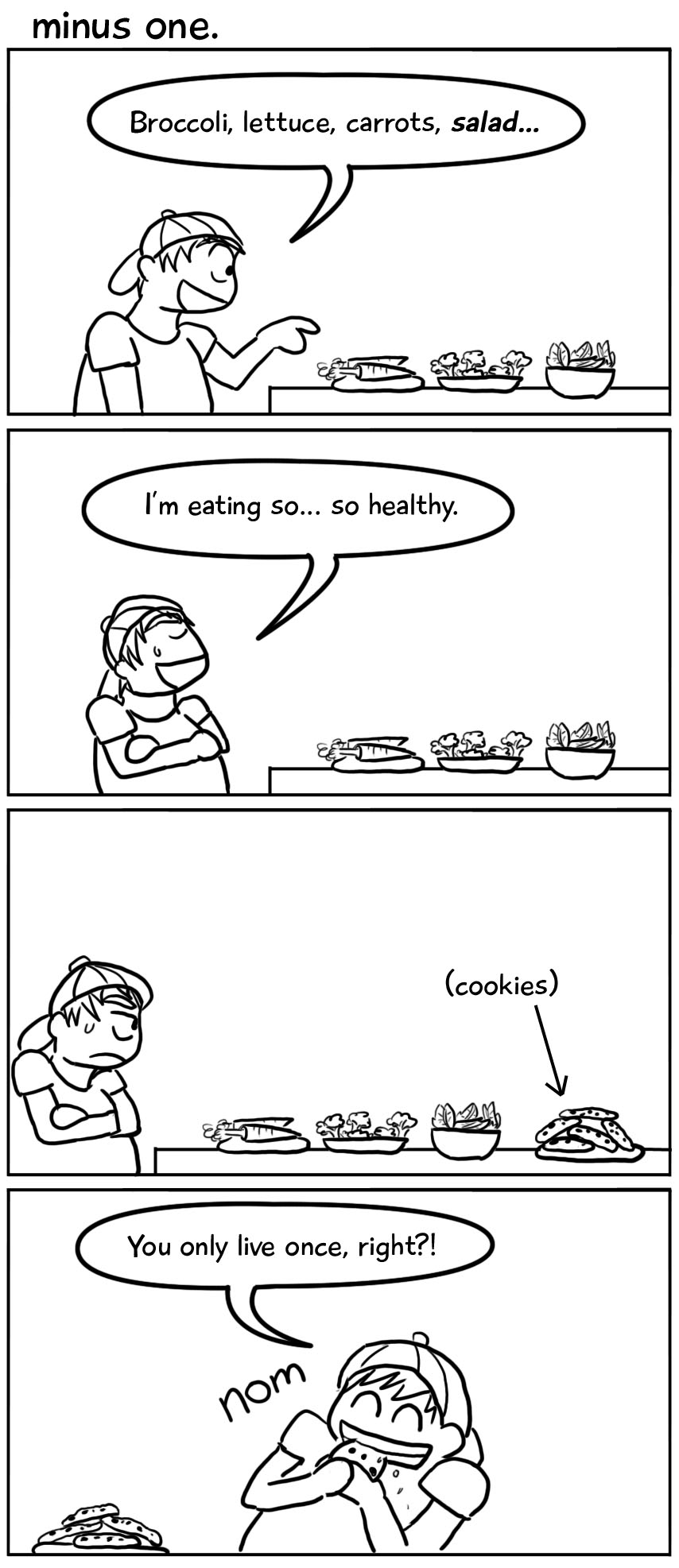

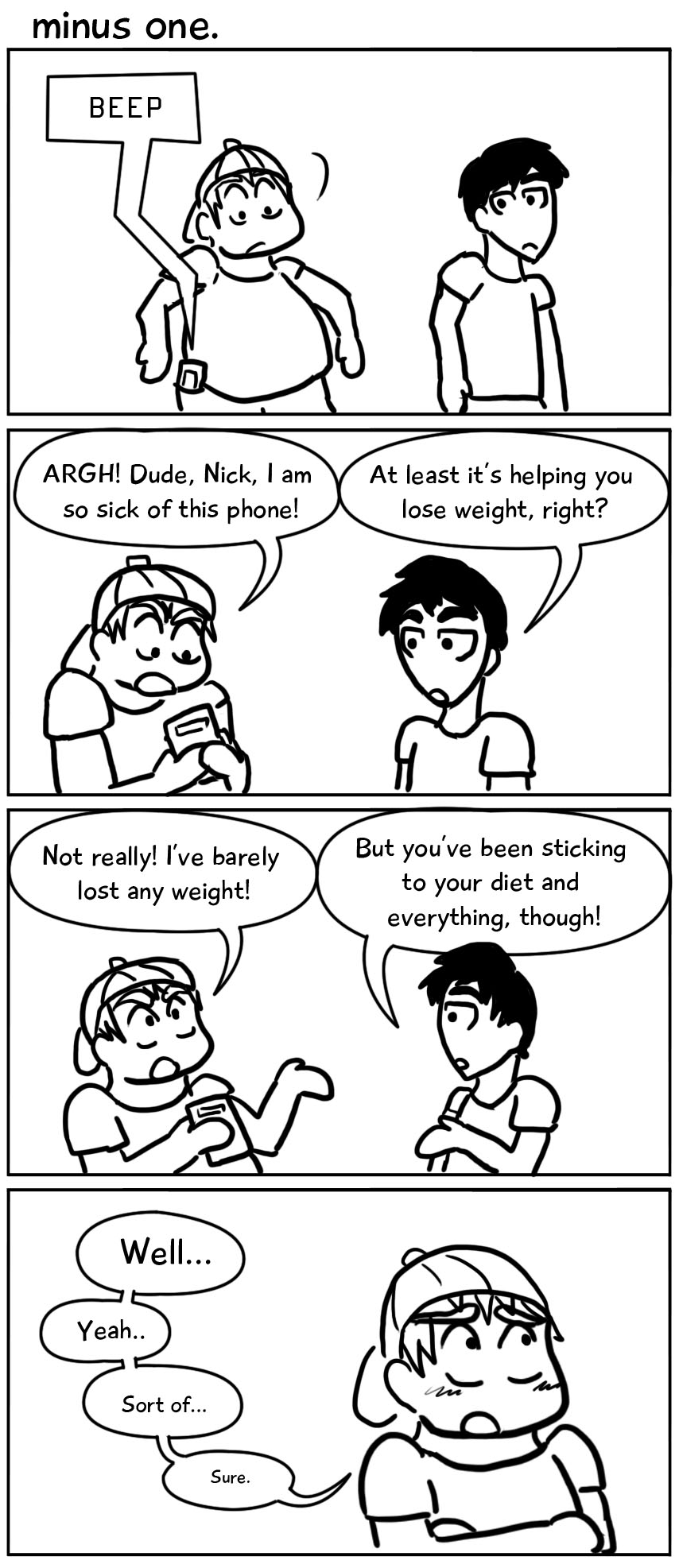


Changes to the phone– such as the addition of this comic.

I’m back in America.
I’ve been back for about a week now, since the 20th. I haven’t been able to blog even then, however, because I’ve had to wrap up my part-time cartooning job, which, by the way, I kind of suck at. So, for the past week, I’ve powered through the remaining 43 comics in queue (out of the 365 that needed to be done) and I can now proudly say…

To clarify, I’ve been working on this comic for about nine months.
So I’m somewhat pleased to announce that I will be releasing my somewhat awful weight loss comic, Minus One, online! On this blog, no less.

So check back here every Saturday to see this ridiculous weight-loss comic unfold! Oh, but first: some disclaimers:

Thus my mediocrity will finally be unveiled to the world.
In better news, however, I’m finally able to start blogging about Japan! Coming soon!
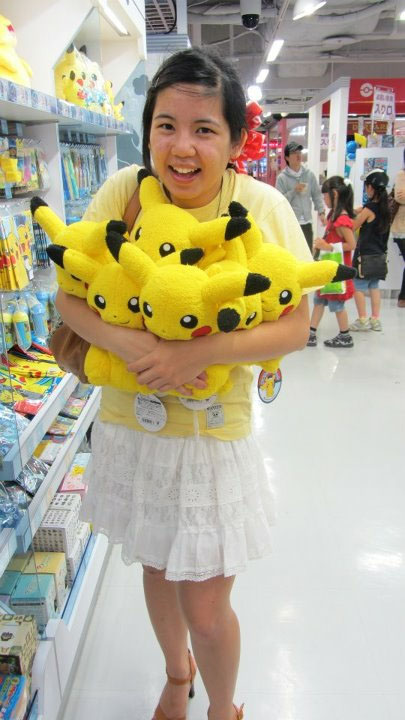
JAPAN!
I have no free time here. It’s past one in the morning already, and I have class tomorrow. Between class and touring and hanging out with our Japanese friends and homework and my god… everything, I have not been able to blog. I feel awful about it, and I have to apologize– I don’t think I’ll be able to blog about to Japan until, well, I return from Japan on the 20th. I have so many stories to tell, and I want them to be good– is that okay?
Until then, please enjoy these photos of food I’ve been eating here. Hopefully they last until I can write about my experiences in full!
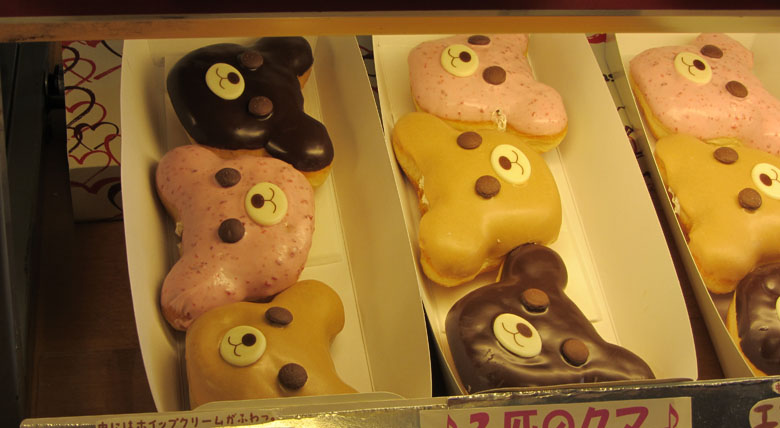
Donuts at a Mr. Donut in Tokyo.
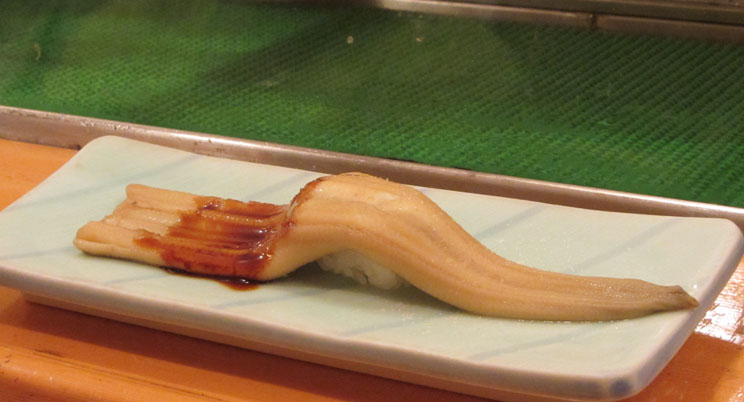
Eel (unagi) at a sushi shop next to Tsukiji Fish Market.
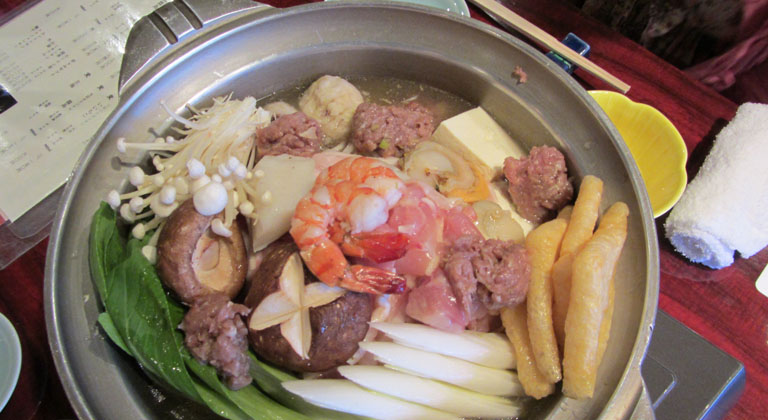
Chankonabe, a traditional dish associated with sumo wrestling.
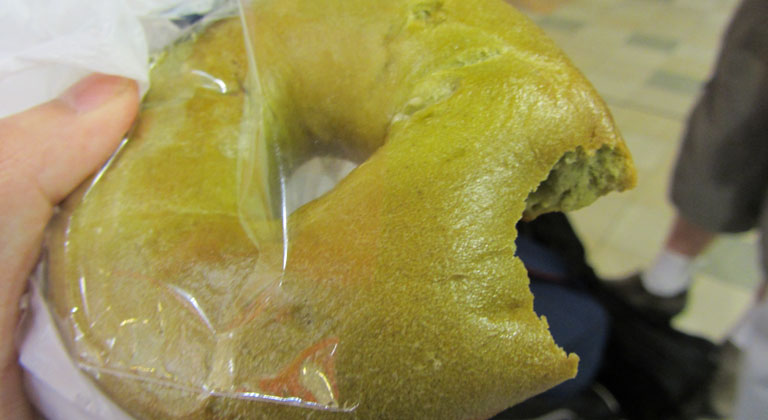
A green tea bagel.
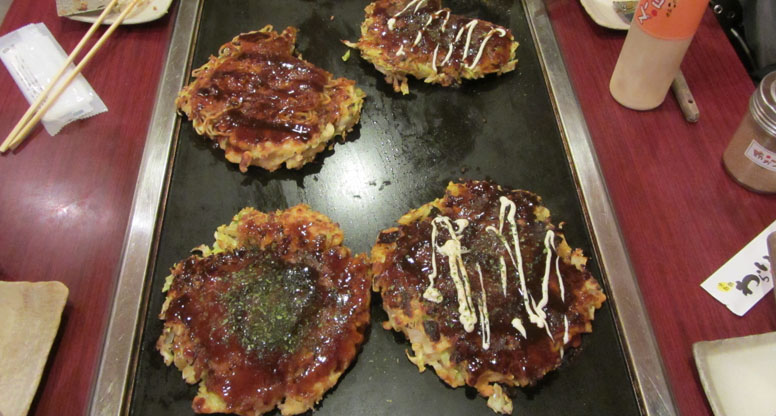
Okonomiyaki, a type of savory cabbage pancake, in Kyoto.
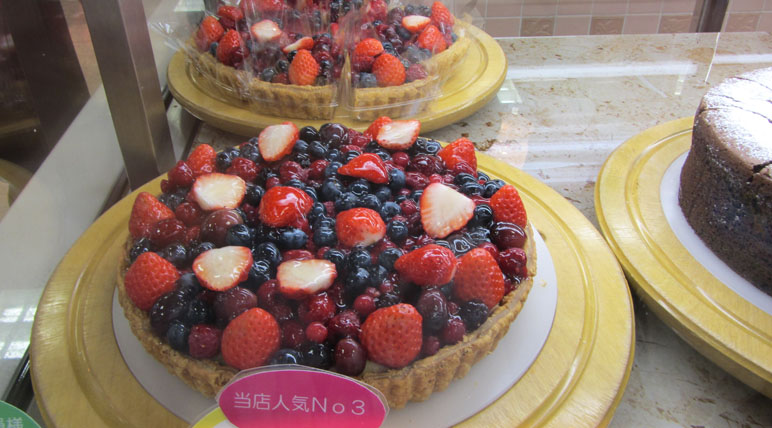
A cake at a bakery in Sapporo Staion.
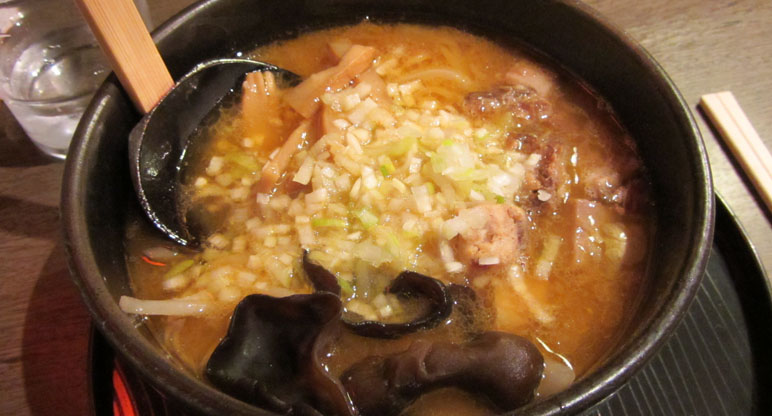
SAPPORO RAMEN IS THE BEST IN THE WORLD
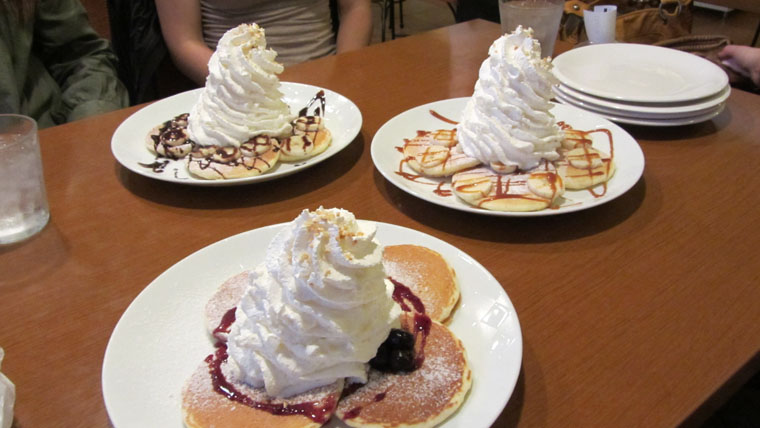
Pancakes at an adorable cafe near our host university.
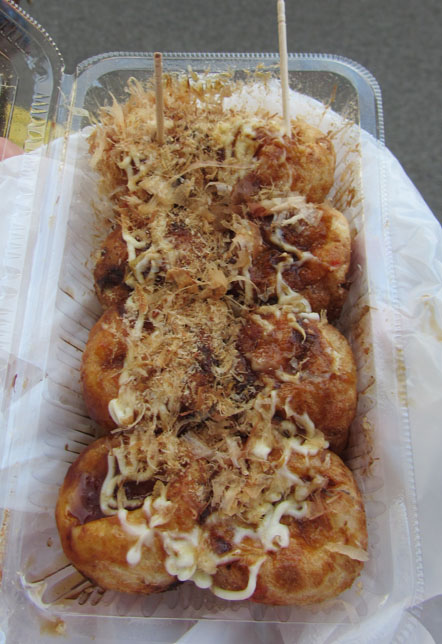
Takoyaki from a truck by our host university.
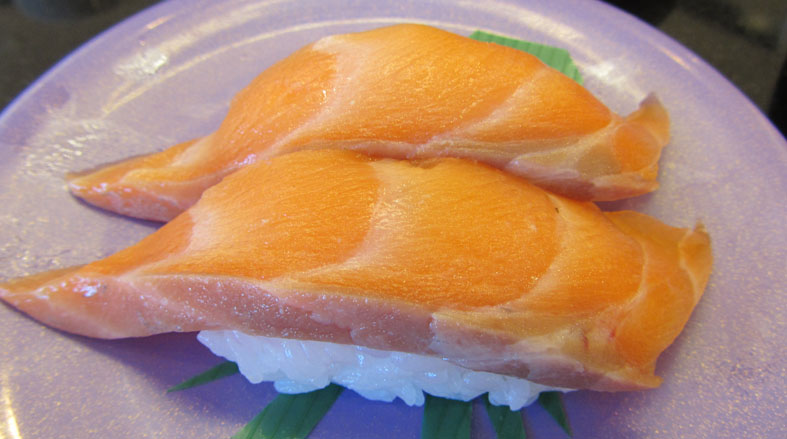
Sushi at a conveyor belt sushi shop in Otaru.
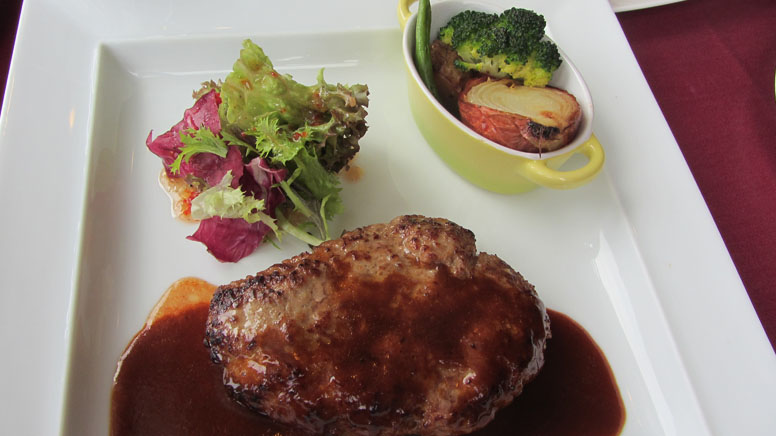
A hamburger steak in Furano.
So it might not be soon– but I will blog about the crazy places and things and people I’ve been able to experience here in Japan! For now– I hope this is enough.
Bridging languages can be problematic. We’ve all seen Engrish. Things get lost in translation. And as a college student learning Japanese, I find communicating somewhat difficult.
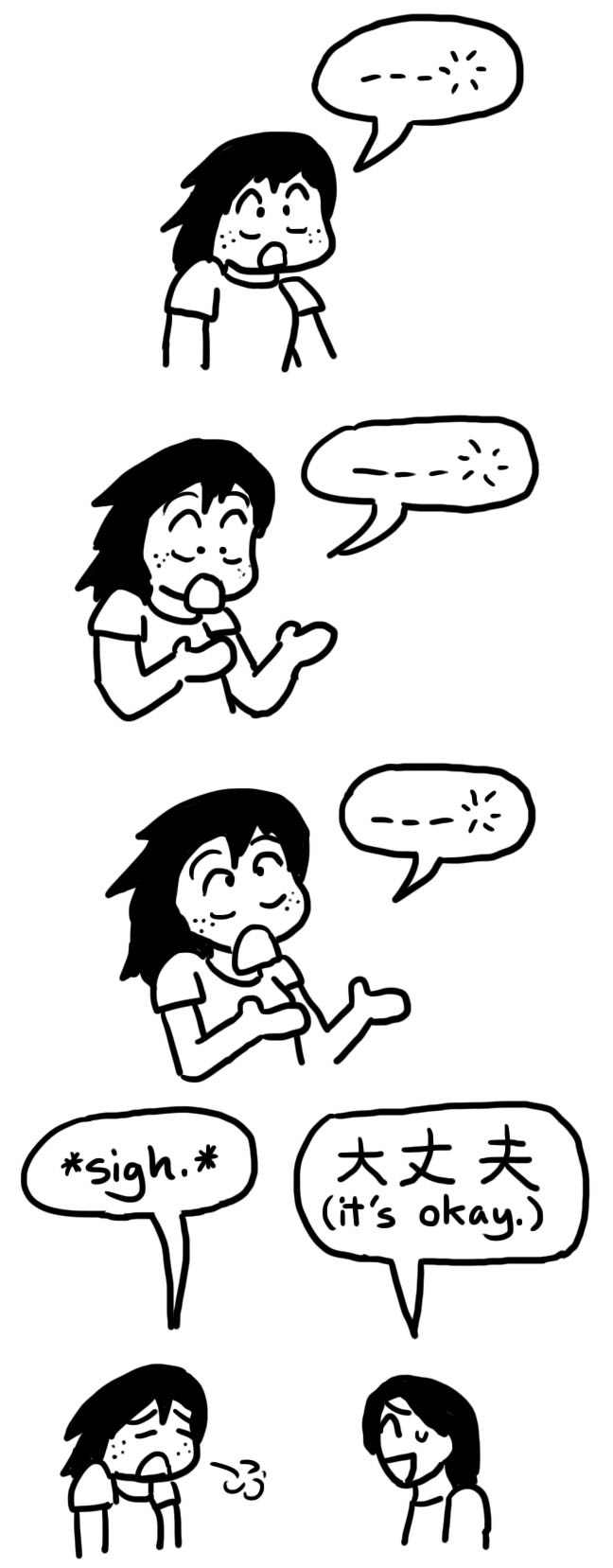
As a result, I’ve been resorting to something my group has coined “Nihonglish,” a portmanteau of nihongo (日本語、meaning Japanese) and, obviously, English. It looks kind of like this:
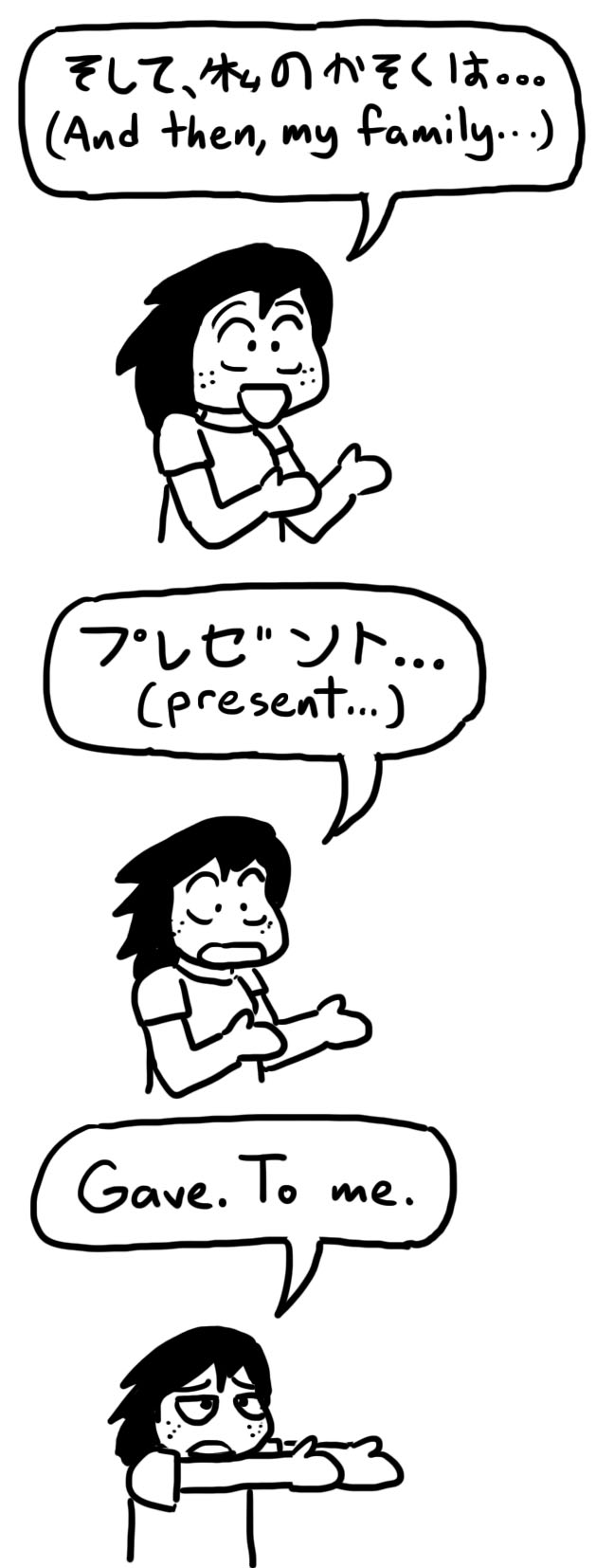
And I’ve had to communicate quite a lot. I mentioned it before: here in Sapporo, we’re doing a short-term program with a local university. On most weekdays we meet up with various Japanese college students to hang out and speak Japanese with them. It’s a great experience and really good for practice—but definitely hit the language barrier.
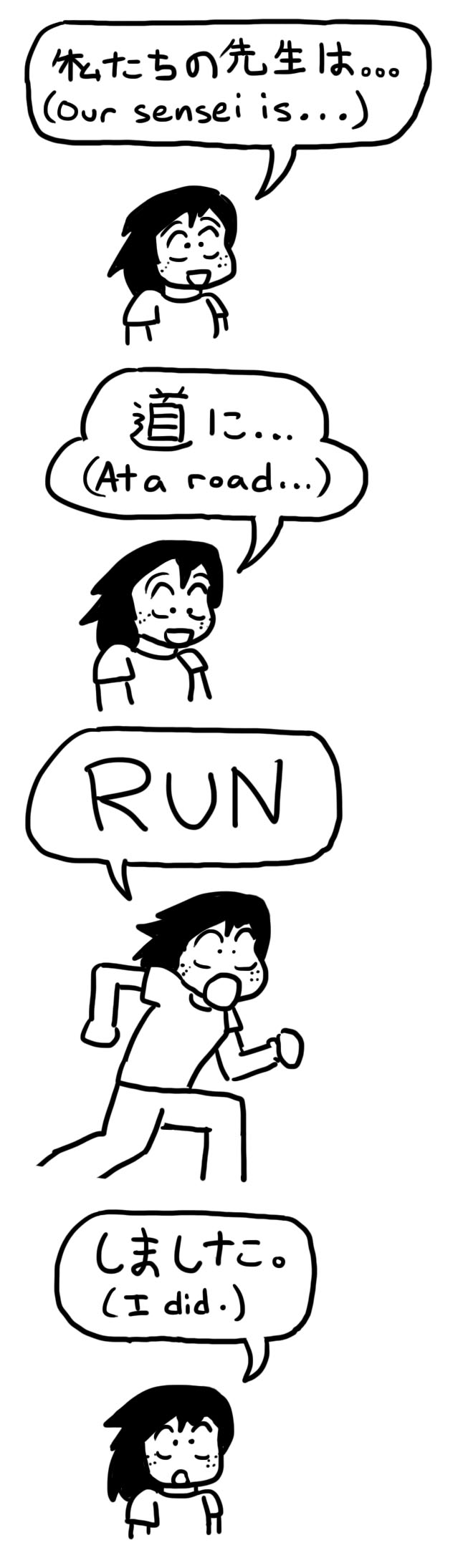
Luckily for us, most Japanese kids start learning English in middle school, so most of our college kids are able to understand a bit of English. I also have a habit of gesturing wildly, which usually helps me get my point across. However, my vocabulary is extremely limited. Heck, I don’t even know the word for “to open:”
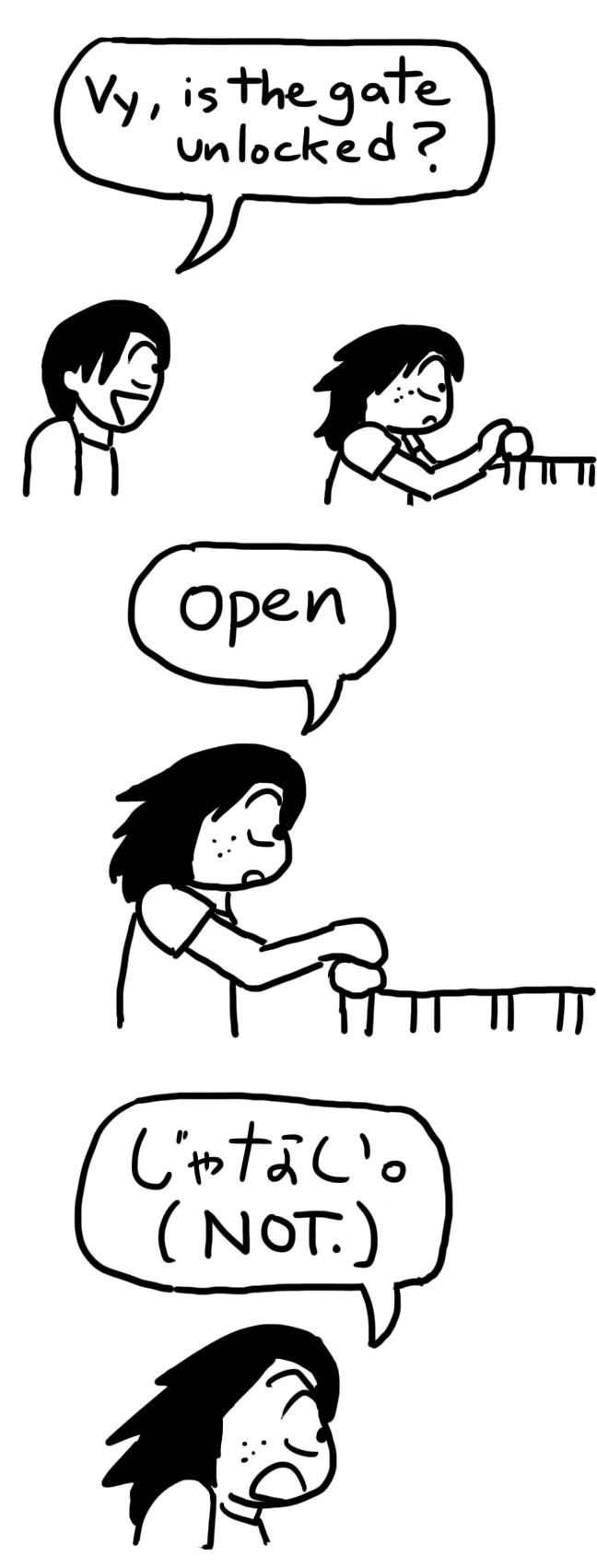
(As an explanation to those who don’t know Japanese: “Janai” is a common suffix used to make adjectives negative. For example, kirei (clean) turns into kireijanai (not clean))
I’ve even starting doing it while talking to my fellow Americans.
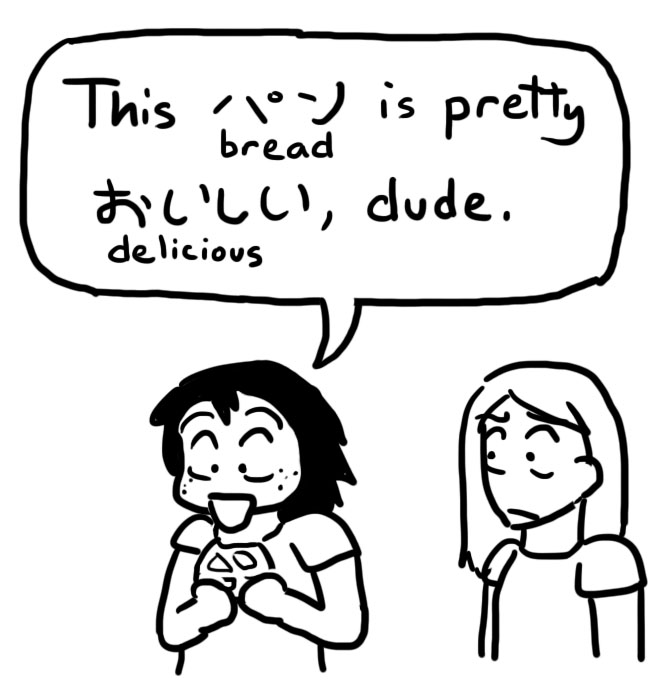
My group has taken it to the point of coming up with our own nihongo slang. For example, a common phrase in Japanese is daijoubu (大丈夫, meaning are you okay? Or, I’m okay.) Except we decided to shorten it to

Or even worse,
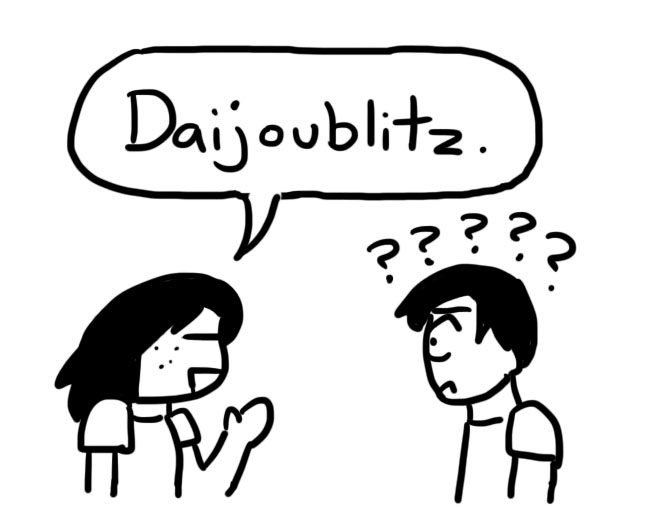
Which is all a bit incomprehensible to our conversation partners. But, hey. At least we’re trying. Anyway, even our sensei fell victim to the Nihonglish trap:
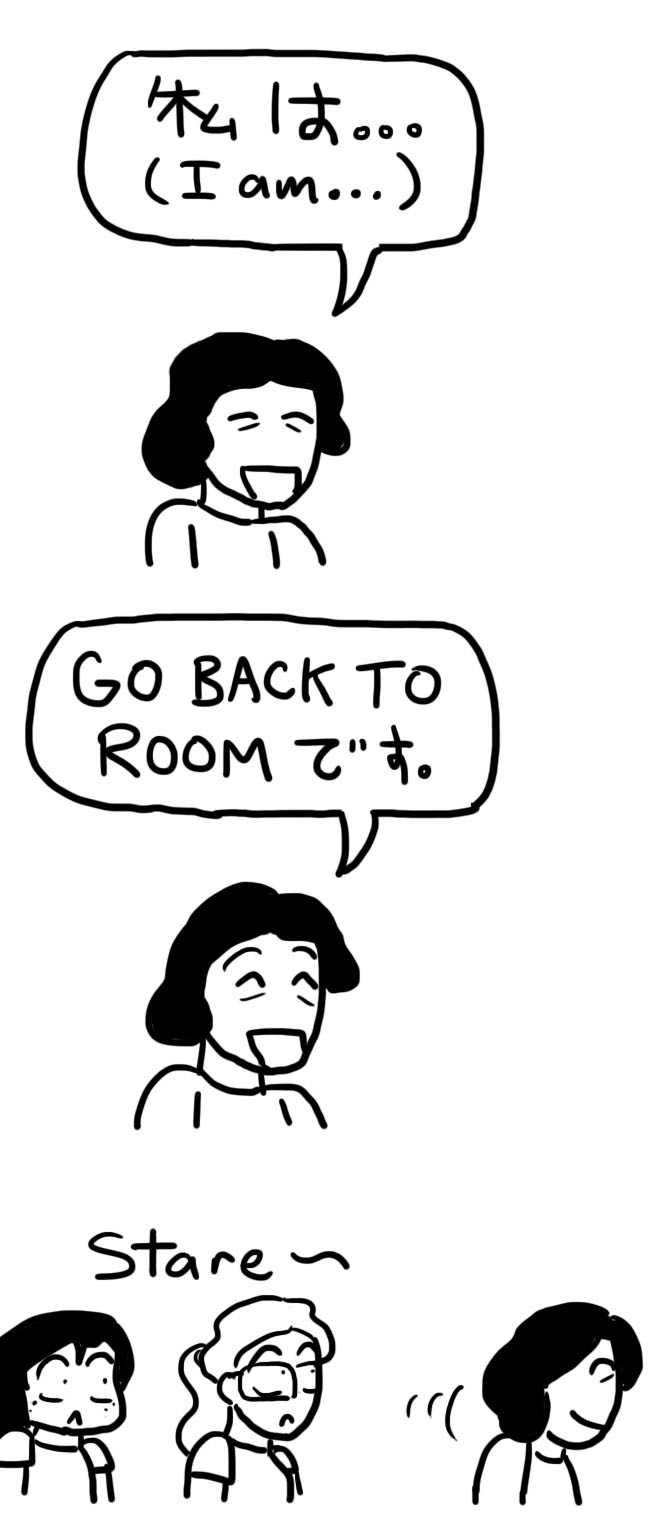
But I feel as though I’ve improved, though only a bit. I’ll keep trying my best!
The internet here is very variable… I apologize. I haven’t been able to access internet for the last four days. But I’ll try my best!
My group is in Sapporo now, where we’re actually doing the real learning part of our trip. In Tokyo and Kyoto, we mostly ran around trying to visit every attraction possible. In Sapporo, we’re actually going to class every morning. (3 hours straight!) Afterwards, we go out to experience more Japanese culture, and then in the evening we speak with various Japanese conversation partners. In other words… we’re still ridiculously busy.
One of these “cultural experiences” was ikebana, (生け花, literally putting life into flowers) the Japanese art of flower arrangement. Basically, you put… flowers… into vases… so that it looks nice. There’re actually several different styles and rules, with the composition depending on the shape of the vase, the season, and the flowers available.
It’s more difficult than it sounds.
At our host university in Sapporo, we attended an ikebana demonstration with one of the professors. She explained the basics of ikebana, about how it needs to be an asymmetrical triangle, needs to suggest 3D space, and is meant to be viewed from only one angle. Of course, this was all in Japanese, so I understood about… zero.
Then, each student was given a vase and a bunch of flowers to have at it. Now, I understand these concepts now—after I had our sensei translate for me—but at the time, I was perplexed.
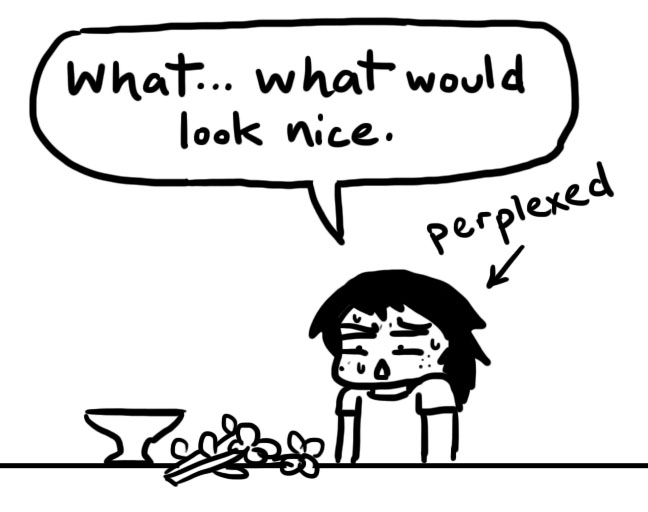
Well, whatever. I had at it.

I eventually hit a roadblock, right around here:
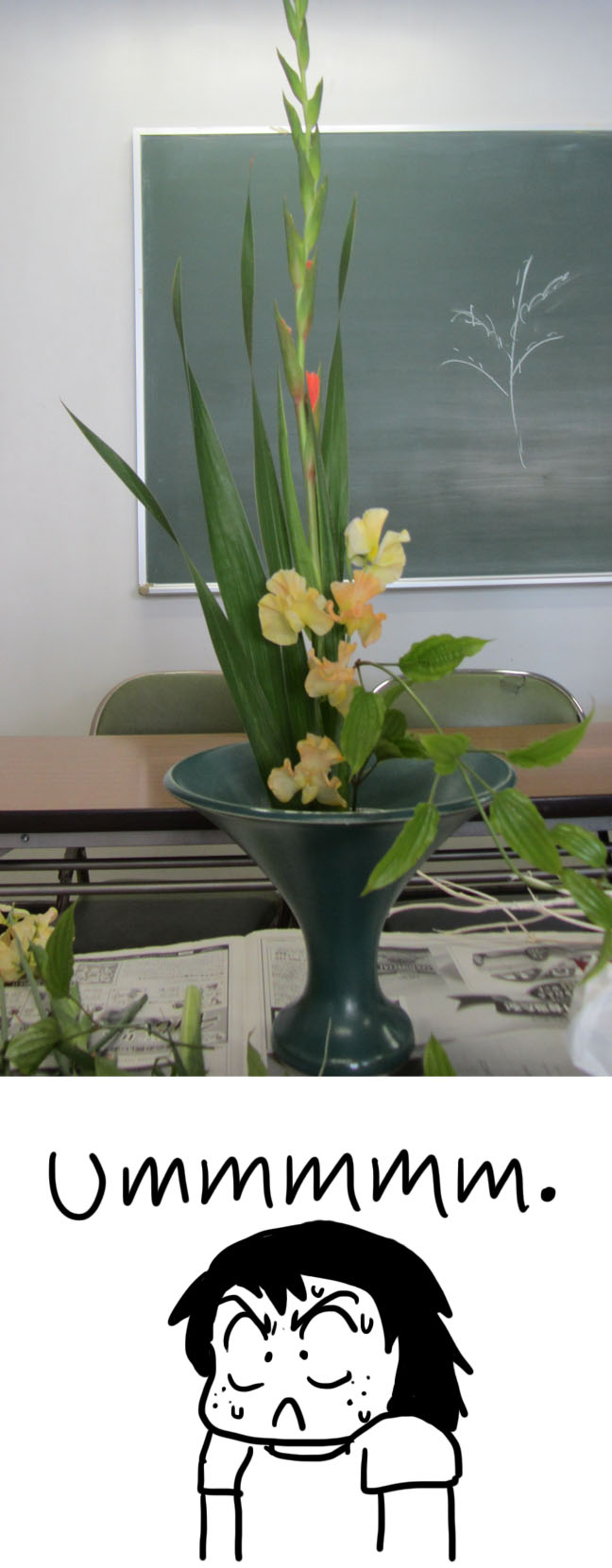
There was nowhere to go. And then I found help from above, from one ikebana sensei:

She started trying to fix it.
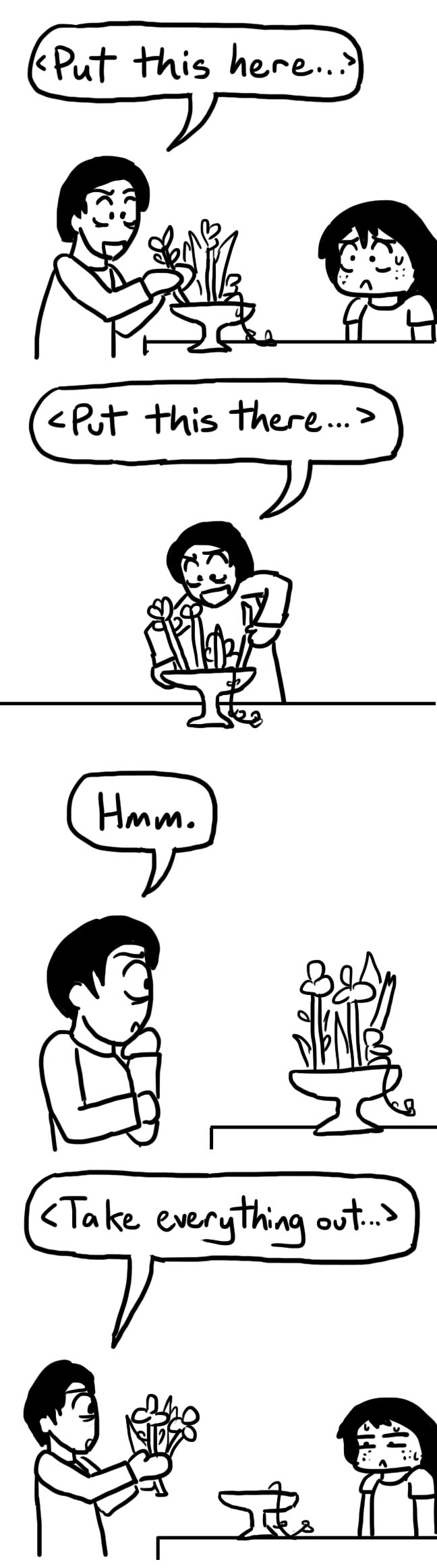
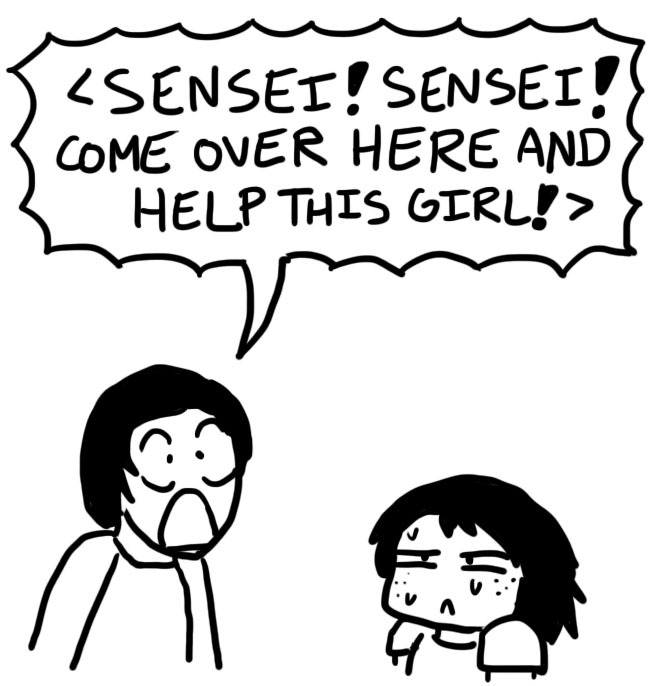
After a couple minutes of frantically trying to revise my ikebana, she finally had to call over the other ikebana sensei.
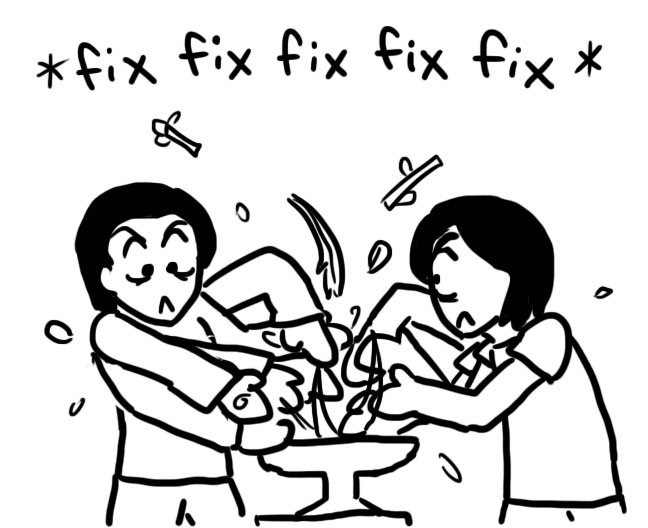
So for the next five minutes, my ikebana received the full treatment.
Then, when they were done…
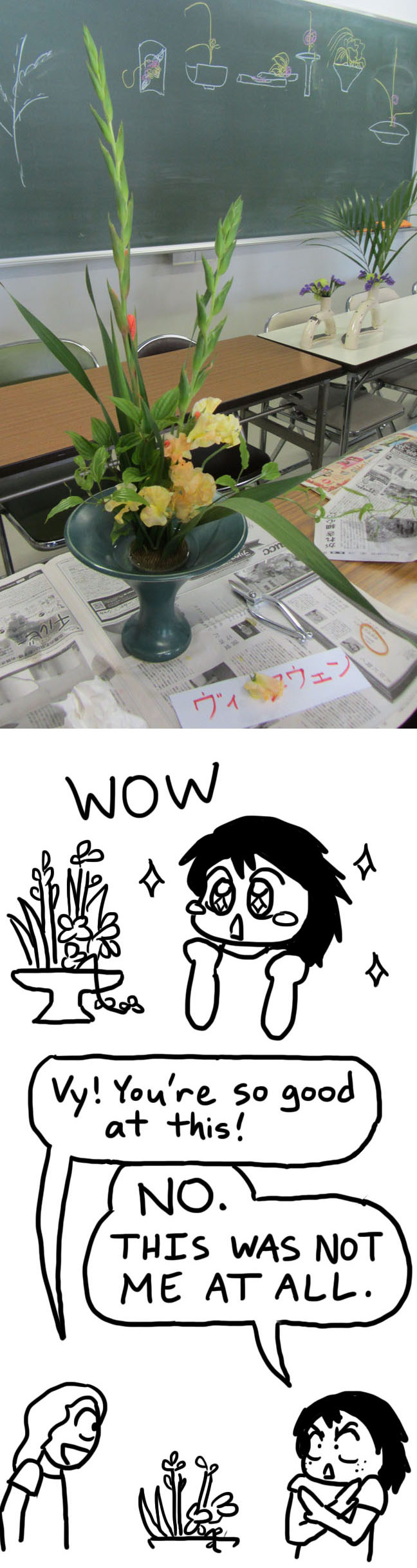
And then I had a huge case of déjà vu the next day when we tried shodo, the art of Japanese calligraphy.

After practicing about ten times with the shodo sensei watching my every move, though, I did manage to write a pretty decent ai, the character for “love”:
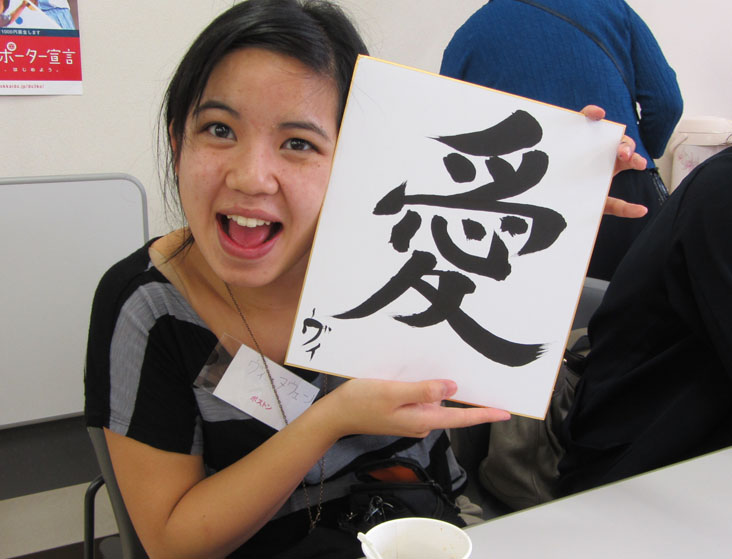
Welll, I’m trying. And I totally loved both arts, shodo especially. Now to find a brush and ink to bring back to the US…
Temples are to Kyoto as castles are to Germany. They’re everywhere. Big and small, seemingly around street corner, you’ll find a temple in Kyoto. Needless to say, while my group was in Kyoto, we ran around endlessly visiting tons and tons of temples and shrines.
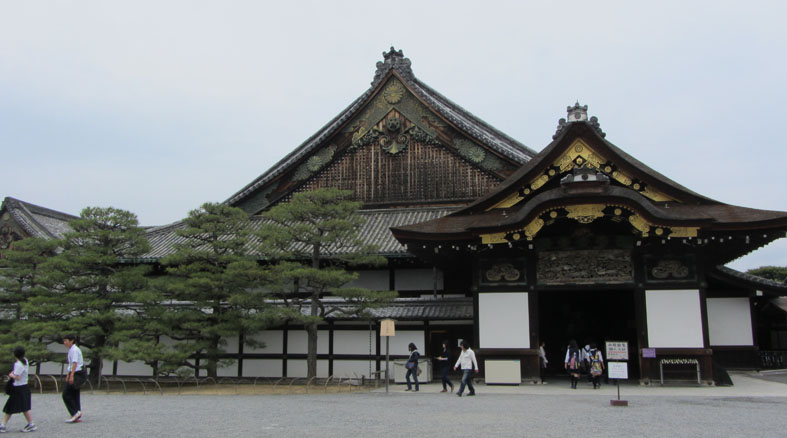
Nijo Castle.
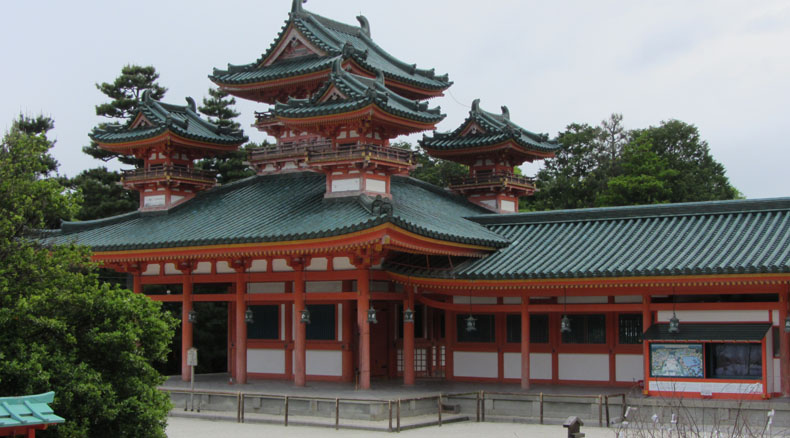
Heian Palace.
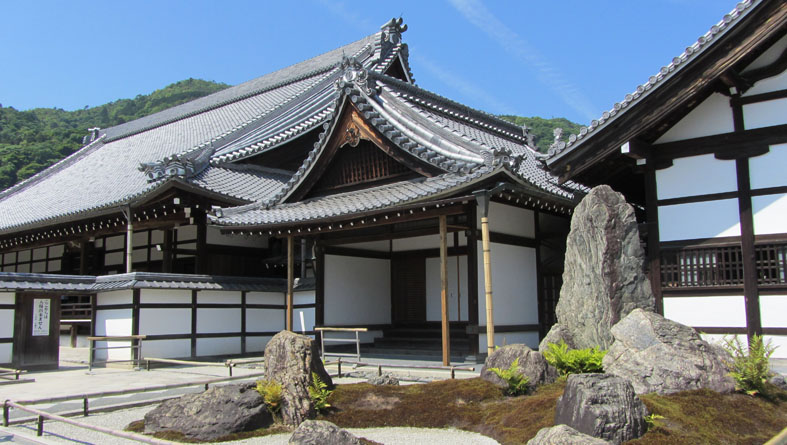
Tenryuji.
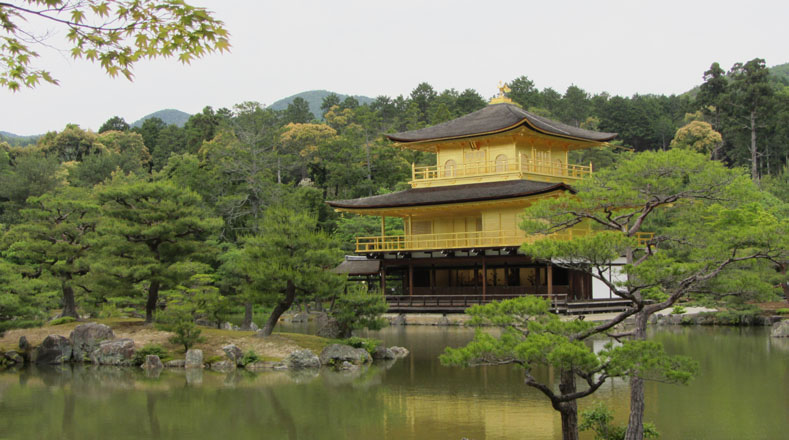
Kinkakuji. The temple is covered with a very thin gold leafing.
On our last day in Kyoto, my group actually had half the day free. But instead of going home and sleeping as we all desperately needed to do, we opted to visit yet another temple.
Hey. Might as well keep the streak going.
The Kiyomizu-dera (清水寺, literally clear water temple) is a temple literally built into a mountainside, a little ways up from the city itself. As a result, the temple offers amazing views of the city, which are especially popular during the cherry blossom season and autumn. Still, visitors flock to Kiyomizu-dera at all times of the year. Three other students and I decided to join the fray.
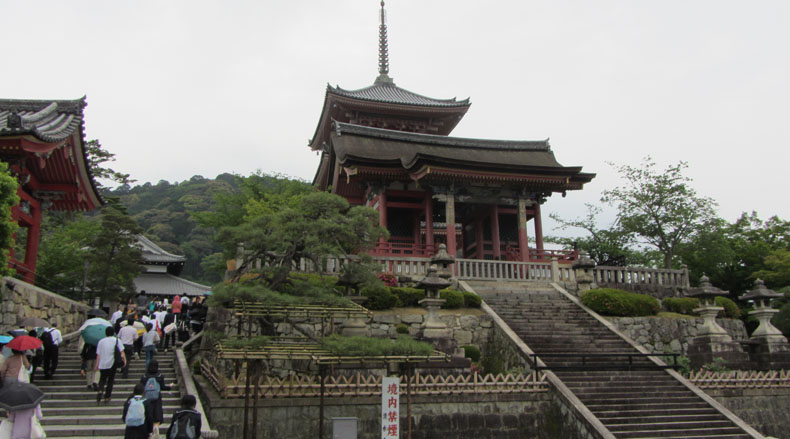
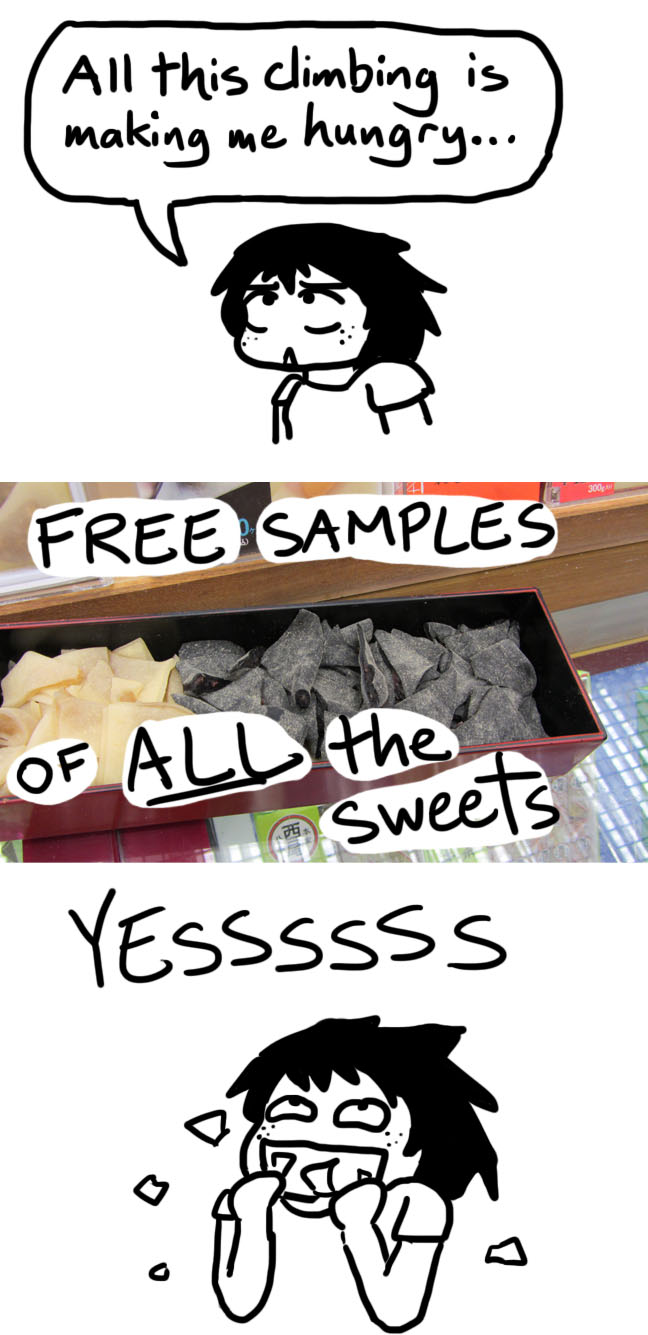
Kiyomizu-dera is definitely a tourist attraction, and we could tell. The street leading up to the temple was lined with stores selling everything from sweets to food to fans to the area’s famous Kiyomizu-yaki pottery.
The Kiyomizu-dera was as awesome as rumored. It was raining by the time we got there, but the view was still incredible:
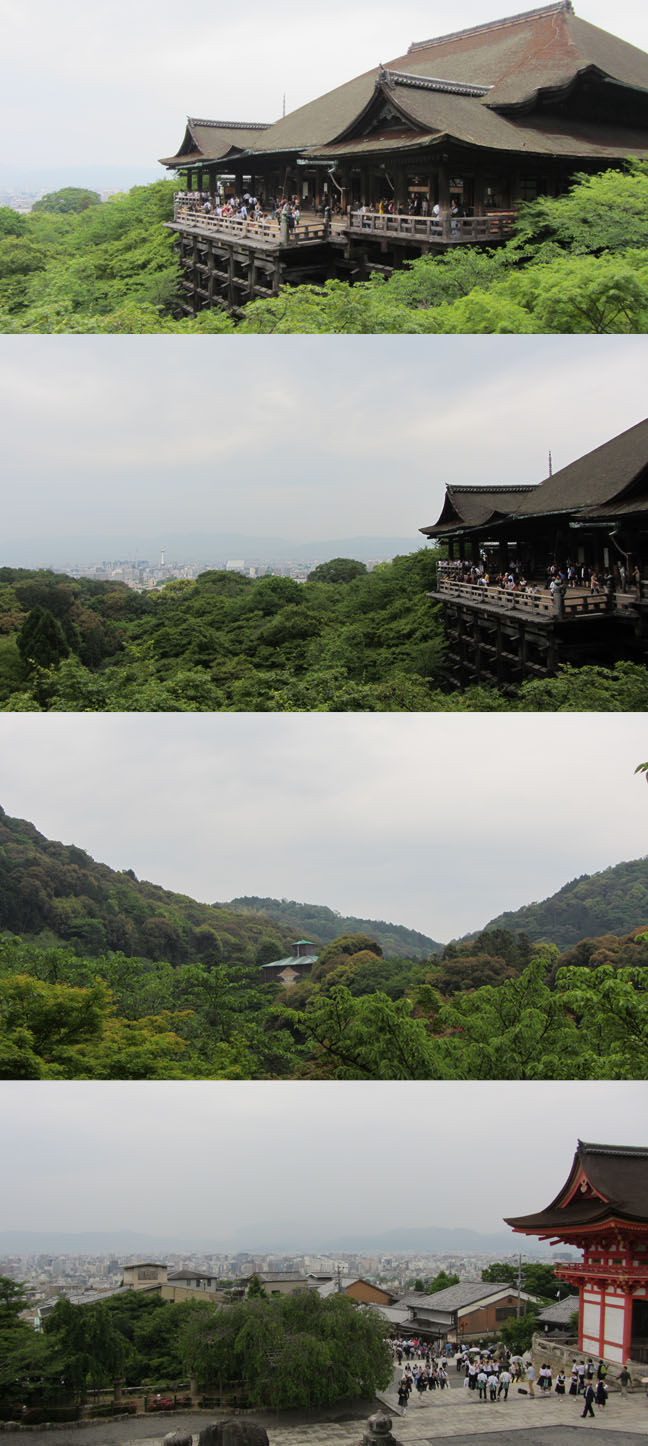
And it turns out that the Kiyomizu-dera was not the only shrine there. My group stopped by the Jishu Shrine, devoted to the god of love and matchmaking.
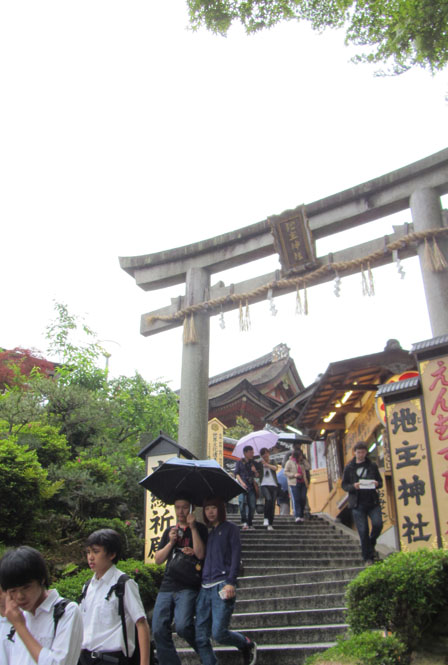
The most famous attractions at the Jishu Shrine are the love stones. These two stones are placed about 20 feet apart. It is rumored that if one can walk safely, with their eyes closed, from one stone to the other, the person will soon find true love. If assistance is given, however, a go-between will be needed. Thus the area was crowded with schoolgirls trying to find their love:
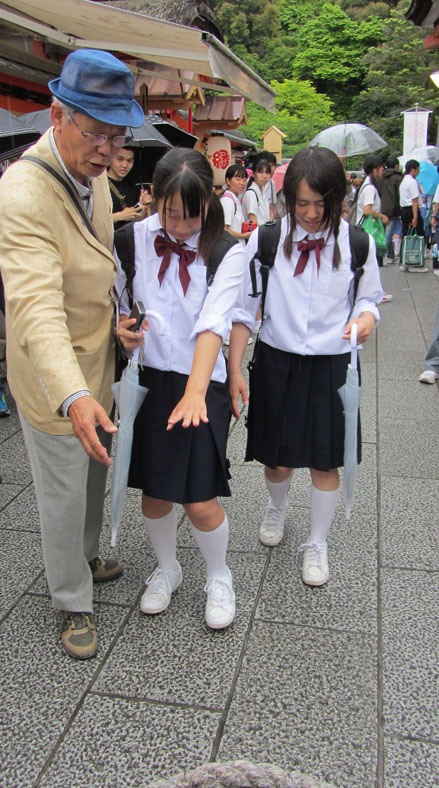
And of course I had to try it as well.

I walked forward, bumping into the dozens and dozens of people swarming the shrine…

I’m rather unbalanced, so I walked slowly. Very slowly. To the point where people started becoming impatient…
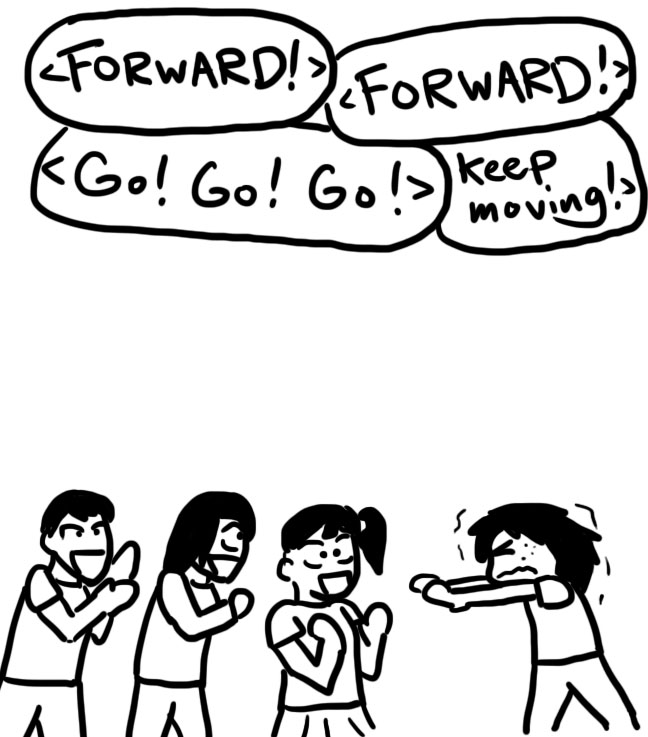
And then I started going off track…

I reached out with my hands, frantically searching. And then… finally…

Apparently, I will find my true love—but only with the assistance of, oh, a dozen or so people. Figures.
Still, Kiyomizu-dera was gorgeous. The temple was full of shops selling charms and fortunes. There were numerous shrines to make an offering at (usually spare change) to make a wish for the gods. Kiyomizu also features the famous Otowa waterfall, which is divided into three streams for visitors to drink from. Drinking the water also apparently grants your wishes.
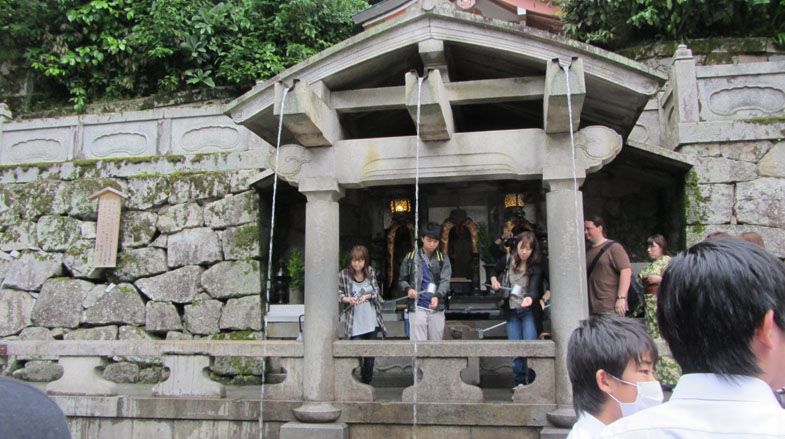
These temples are just full of superstition. But, hey. I might need twelve people to find my true love—but I will find it in the end, right?
For those who are interested– there are more photos on my tumblr!
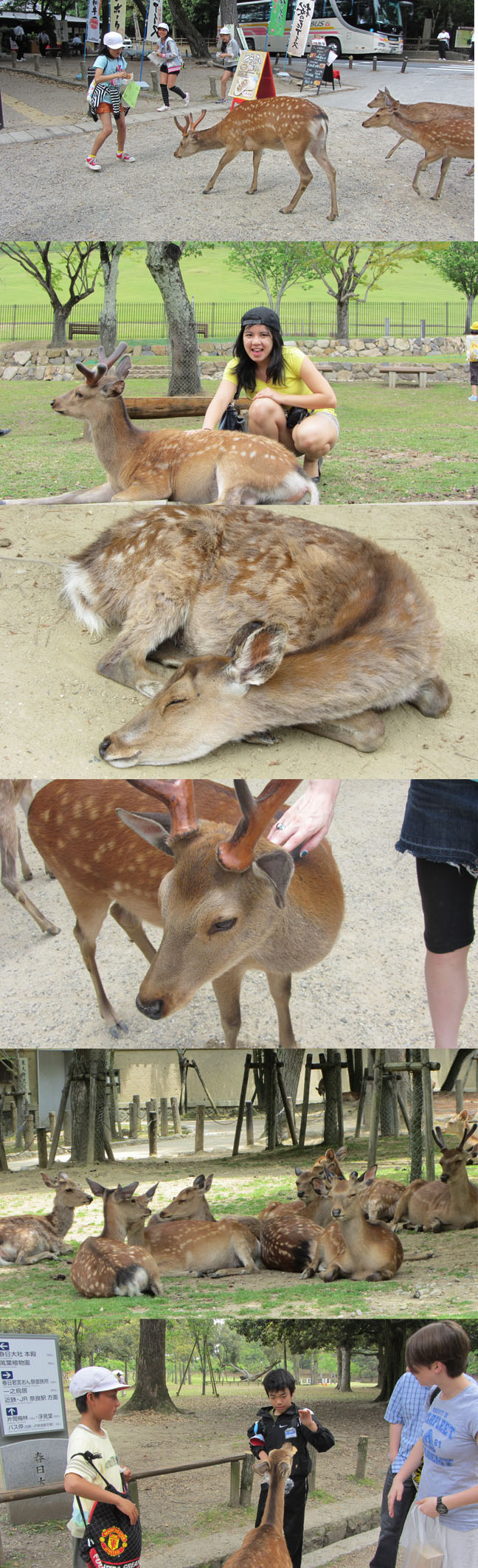
There’s this little city about an hour outside of Kyoto called Nara. Nara is famous for its several temples, its numerous stone lanterns, and its countless deer.
Yes. Deer.
Deer, according to legend, are heavenly animals. They protect the people and the city of Nara. As a result, Nara residents have historically revered deer, and do not harm them.
So the deer take advantage of it.
Modern day Nara is swarmed with deer. Deer have grown accustomed to humans, since we feed and pet and don’t harm them. It’s gotten to the point where they’re a huge tourist attraction for both Japanese and non-Japanese alike.
They were a tourist attraction for us, too. One day in Kyoto, we decided to escape to Nara instead. We hopped on a train to Nara, where our sensei had set up volunteer English tour guides to take us around the city.
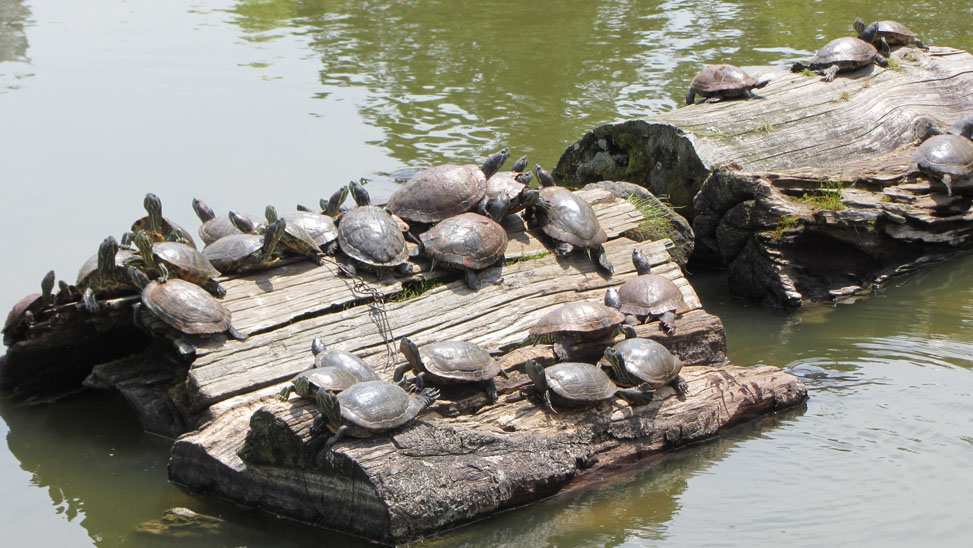
We started with the Sarusawa-ike pond, where captured fish is often released. I saw more turtles than carp, though.
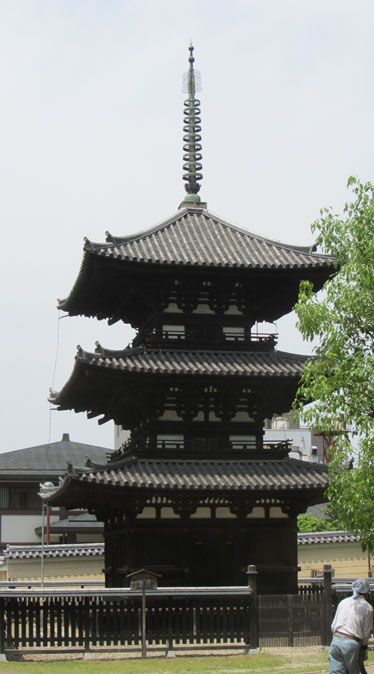
And then we moved on to Kohfukuji, one of the many famous shrines in Nara.
And then.
I saw them.
The deer.
There are stands all over Nara selling senbei, crackers that tourists can feed the deer. Deer tend to hang around these stands. There was a stand at Kohfukuji, and thus a little patch of deer just chillin’.

My first reaction was to scream.

Second was to run up and pet them.

And then I immediately purchased some senbei. Which seemed like an excellent idea, until…

If you have food, these deer will get it. They will chase you. They will push you. They will eat your clothes.

And I was thus harassed by deer in Nara.

This wasn’t going to work. I was saved by the ingenuity of a fellow student:

I quickly passed out the remainder of my senbei so the deer could go and bother other kids.
In all honesty, though, Nara was kind of…super awesome yo. The deer, especially the adults, are friendly and let you casually walk up and pet them. And the deer bow. The deer bow. There is actually a correct way to feed the deer, besides running-away-while-frantically-holding-out-bits-of-cracker, which looks like this:

I took a video, which I wish I could post—but here in Sapporo, I’ve been unable to connect my laptop to the internet. The old computer they have here is a bit too slow to handle youtube uploads. Perhaps when I get home. But I swear it’s true—the deer will bow to you to ask for food.
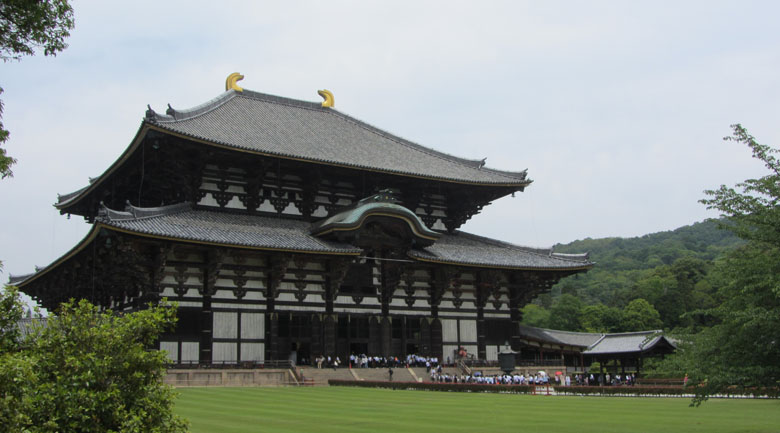
Nara’s got more to it than just deer, though. There are several shrines, including the Todaiji, the largest wooden structure in the world:
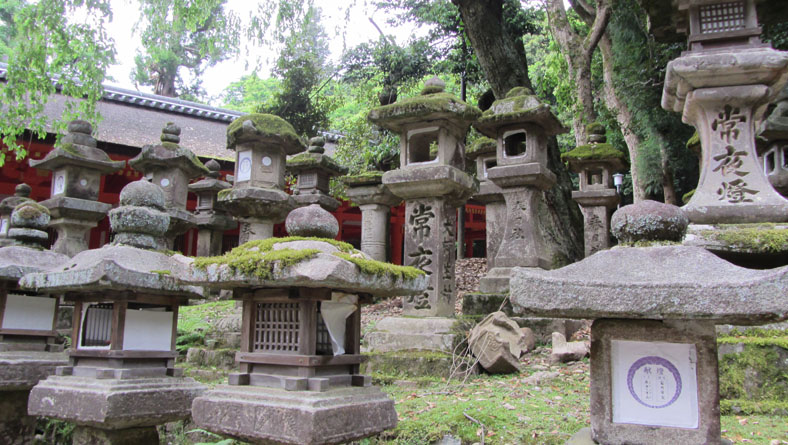
There’s also a forest path lined with hundreds of stone lanterns. During Obon, every single lantern is lit with candles. It was already quite a sight in the daytime.
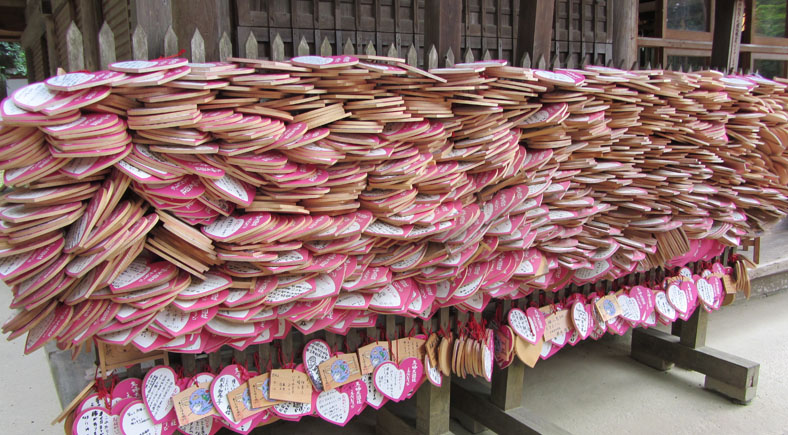
A big thing at temples is to purchase small wooden tablets on which you can write wishes to the shrine’s god. In Nara, perhaps because it’s swarmed by schoolkids, love wishes seemed to be popular. Very popular.
So yes, Nara was pretty darn cool. I’ve never been anywhere like it—but I suppose that’s a common theme on this trip of mine. And on that note—please enjoy this plethora of deer photos!